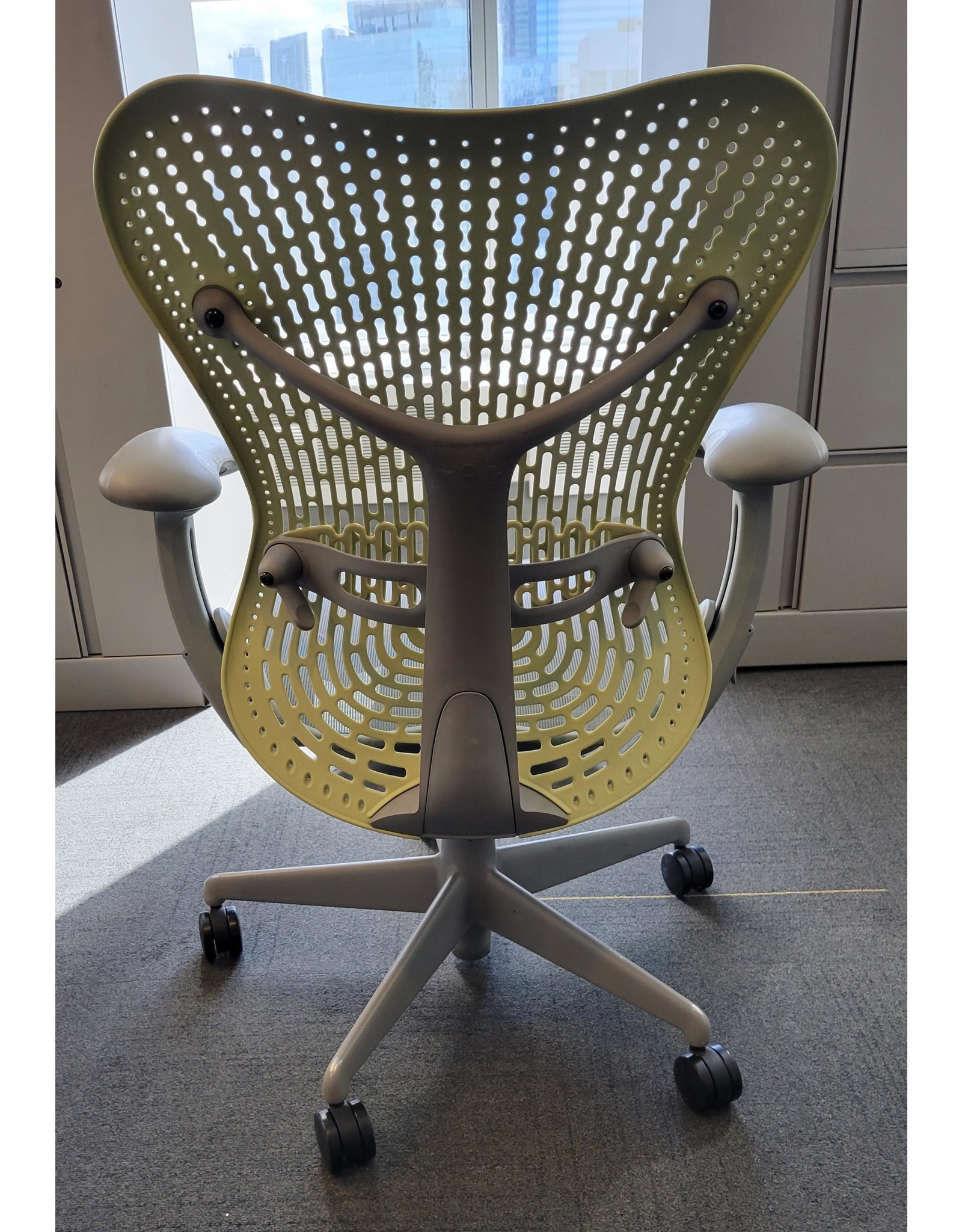
Honestly, the office chair market is a mess right now. You’ve got these flashy "gaming" thrones that look like they belong in a race car but feel like sitting on a plywood board after two hours, and then you have the high-end ergonomic giants that cost more than a used hatchback. Right in the middle of that chaos sits the Herman Miller Mirra 1. Even though it’s been technically succeeded by the Mirra 2, the original model—designed by Studio 7.5 back in the early 2000s—is still floating around the used market in massive quantities.
People always ask me if it's just a "budget Aeron." It’s not. It’s a completely different beast. While the Aeron is the suit-and-tie of the chair world, the Mirra 1 is more like a high-performance running shoe. It’s meant to move with you, not just hold you in a fixed position. If you're hunting for a deal on a refurbished office chair, you’ve probably seen these listed for $250 to $400, and you’re wondering if a twenty-year-old design can actually save your lower back.
The short answer? Yeah, it can. But there are some serious "gotchas" with the Mirra 1 that nobody really talks about until they’ve spent eight hours a day in one.
Why the Herman Miller Mirra 1 Design Was Radically Different
When Bill Stumpf and Don Chadwick designed the Aeron, they went for mesh everywhere. But when Studio 7.5 took on the Mirra project, they wanted something "leaner." They looked at how people actually sit—shifting, leaning, reaching for coffee, slouching when they're tired. They realized a rigid frame is the enemy of comfort.
The Herman Miller Mirra 1 introduced the Triflex back. It’s basically a big sheet of molded polymer with holes of different sizes. This wasn't just an aesthetic choice. The holes are mapped to your spine. They’re smaller where you need more support and larger where you need the chair to flex. When you lean back, the plastic actually stretches and twists. It feels weirdly organic.
You’ve probably seen two versions of the backrest: the naked plastic "Triflex" and the "Butterfly" back, which has a thin fabric layer over the plastic. If you find a used one, check the Butterfly back carefully. The fabric on those older models tends to delaminate or get incredibly dusty over a decade of use. Honestly, I prefer the naked plastic. It’s easier to clean, and it looks a bit more "industrial cool."
The "Loop" Spine
One of the most distinct features of the Mirra 1 is the single-piece molded loop that connects the back to the seat. This creates a "passive" flex. It doesn't rely solely on a mechanical hinge; the material itself is the suspension. It’s a brilliant bit of engineering, but it means the chair has a very specific "springy" feel that some people find unsettling at first. You aren't just sitting on it; you're sort of suspended within it.
The Features That Actually Matter (And the Ones That Break)
Let's talk about the seat. This is where most people get tripped up. The Herman Miller Mirra 1 uses "AireWeave" mesh. It’s breathable, which is great if you live in a place like Texas or Florida and don't want a sweaty back. But the Mirra 1 seat has a very firm front edge.
Herman Miller included a "FlexFront" adjustment. You can basically roll the front of the seat up or down to change the seat depth. It’s a mechanical lever system. In my experience, this is one of the first things to go on a used Mirra. If you’re buying one, check if that front edge stays locked. If it slips, the seat will feel like it’s dumping you out, or it’ll cut off the circulation to your thighs.
- The Lumbar Support: This is a physical plastic "bow" on the back. You can slide it up and down and tighten it. It is aggressive. If you like a gentle hug, this might be too much. If you have a flat lower back and need a chair that forces you into a healthy curve, it’s a godsend.
- The Armrests: These are the famous "4D" arms. They go up, down, wide, narrow, and they pivot. The pivot is the best part. When you're typing, you can angle them inward to support your elbows.
- Tilt Limiter: Most Mirra 1s come with a tilt limiter and forward tilt. Forward tilt is a niche feature—it’s for "perch" sitting when you’re leaning into a task. Most people never use it, but for artists or people who do a lot of paperwork, it’s a game changer.
Mirra 1 vs. Mirra 2: Is the Original Still Relevant?
Herman Miller released the Mirra 2 in 2013. They made it lighter, smaller, and refined the backrest. A lot of people assume the newer version is objectively better. I’m not so sure.
The Herman Miller Mirra 1 feels more substantial. It’s heavier. There’s more metal in the base and the frame. The Mirra 2 uses more composite plastics to save weight and cost. While the Mirra 2 has a more responsive "Butterfly" back, the Mirra 1 feels like a tank. It was built during an era where Herman Miller was still over-engineering everything to justify those 12-year warranties.
The biggest difference is the seat comfort. The Mirra 2 seat is a bit softer, but the Mirra 1 seat feels wider. If you’re a broader person, you might actually prefer the original. The frame of the Mirra 1 is less intrusive. On the Mirra 2, I’ve had friends complain that they feel the hard plastic rim of the seat digging into their hips. You don't get that as much with the 1.
Real-World Longevity
I’ve seen Mirra 1s from 2005 that still function perfectly. That’s insane for an office chair. The mesh rarely sags compared to cheap knock-offs. The gas cylinder is standard, so if it starts sinking, you can buy a replacement on Amazon for $20 and fix it in ten minutes.
The one thing that truly dies is the foam pad under the front of the seat mesh. It’s a little banana-shaped piece of foam. Over ten years, it turns into dust. You’ll feel the hard plastic edge against your legs. The good news? You can buy a replacement foam pad for $15 and tuck it in there yourself. It’s a 5-minute DIY fix that makes the chair feel brand new.
What Most People Get Wrong About Ergonomics
People buy a Herman Miller Mirra 1 and think it’s going to be "cushy." It’s not. It’s a "task chair." It’s designed to keep you productive.
If you want a chair to lounge in while watching movies, don't buy this. Buy a recliner. The Mirra 1 is designed to support you in an active working posture. It forces your pelvis to tilt correctly. This is uncomfortable for the first three days if you’ve been sitting in a crappy $100 "manager's chair" for years. Your muscles actually have to adjust to being supported correctly.
I’ve had clients tell me their back hurt more the first day they used a Mirra. I told them to stick it out for a week. By day five, their "tech neck" was gone. The chair wasn't hurting them; it was correcting the damage they’d done sitting in a sofa-style office chair.
The Used Market: What to Look For
If you’re hunting on Facebook Marketplace or eBay, you need to be a bit of a detective. These chairs were often bought in bulk by corporations. When a company goes bust or renovates, hundreds of these hit the market at once.
- Check the manufacture date. There’s a sticker under the seat. If it’s pre-2006, check the mesh very closely for frays.
- The "Wobble" Test. Sit in the chair and wiggle your hips. There should be very little side-to-side play in the cylinder. If it feels like a bobblehead, the bearing is shot.
- The Arm Pads. The vinyl on the Mirra 1 arm pads likes to crack. It starts as a tiny hairline fracture and then splits open. Replacement pads are cheap, but use it as a bargaining chip to drop the price.
- The Recline Tension. Turn the big knob on the right. It should take a lot of turns to go from "easy recline" to "stiff." If the knob spins freely without changing the resistance, the internal tension spring or gear is broken. Walk away from that one.
Is It Good for Gaming?
The "gaming chair" industry has convinced everyone they need a bucket seat with a headrest. But think about it: gamers sit for longer stretches than almost anyone else. Why would you want to sit in a chair modeled after a car seat? Car seats are designed to keep you from flying out of the vehicle during a crash; they aren't designed for typing or using a mouse.
The Herman Miller Mirra 1 is actually a fantastic gaming chair because it stays cool. When you’re in a high-intensity match, you get warm. Mesh is your friend. Also, the armrest adjustments are perfect for controller use. You can pull the arms in close to your body, so your shoulders are relaxed while you hold the controller.
The only downside? No headrest. Herman Miller doesn't believe in them for task chairs because they think if you’re working, your head should be balanced over your spine, not leaning back. You can buy third-party headrests (like those from Engineered Now), but they are specifically made for the Aeron. Finding one for the Mirra 1 is a bit harder and usually involves some "franken-engineering."
Actionable Steps for Potential Buyers
If you’re serious about picking up a Mirra 1, don't just click "buy" on the first $300 listing you see.
- Test the "Triflex" vs "Butterfly": If you can, sit in both. The Butterfly is softer but holds heat more. The Triflex is "purer" but can feel cold in the winter.
- Audit the adjustments: Ensure the lumbar support (the "wings" on the back) actually stays at the height you set. If the teeth are worn out, it will slide down every time you lean back.
- Measure your desk height: The Mirra 1 has a fairly standard height range, but the armrests are chunky. Make sure they can clear the underside of your desk, or you'll be sitting three feet away from your monitor.
- Budget for a "Refresh": Even a great used Mirra 1 usually needs a new seat foam pad and maybe a deep clean. Set aside $30 and an afternoon to pull the lint out of the casters and wipe down the frame.
The Herman Miller Mirra 1 isn't a status symbol anymore—the Embody and the Aeron Remastered have taken that spot. But as a tool for work? It’s arguably one of the best values in the world right now. It offers 90% of the ergonomic benefits of a $1,500 chair for about 20% of the price. Just make sure the "FlexFront" works, and your lower back will thank you for the next decade.