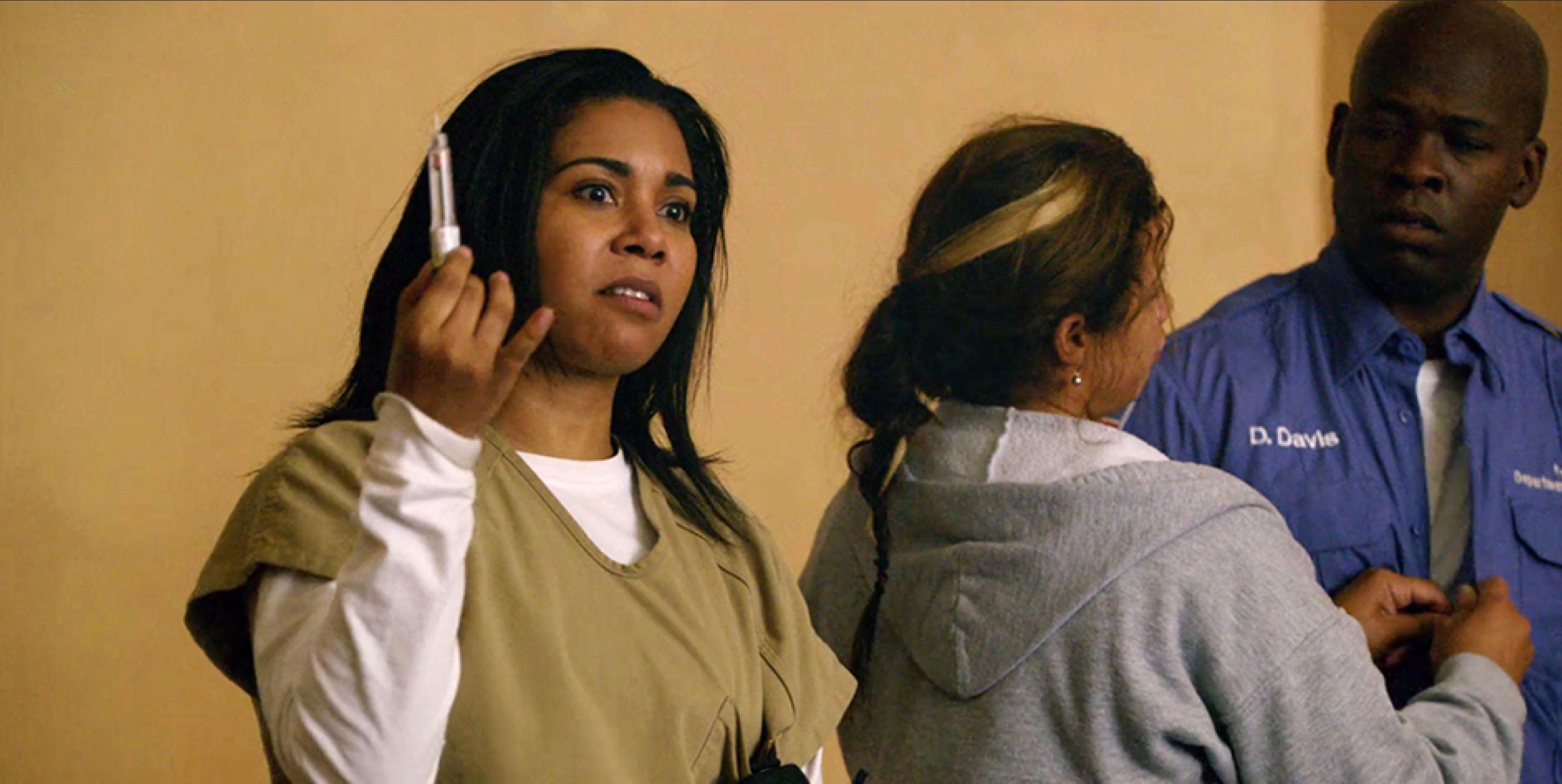
Maria Ruiz is a lot of things. She's a mother. She's a leader. Honestly, for a couple of seasons there, she was basically the closest thing Orange Is the New Black had to a true, cold-blooded villain. But if you talk to fans, they’re split. Some see a woman driven to madness by a system that snatched her baby away minutes after birth. Others see a power-hungry opportunist who branded Piper Chapman with a swastika and betrayed anyone who stood in her way.
The truth is messier.
When we first met Maria in Season 1, she was just "the pregnant girl." She was Dayanara Diaz's bunkmate, quiet and mostly focused on her growing belly. But the writers didn't let her stay in the background for long. Over seven seasons, Maria Ruiz became the ultimate case study in how prison doesn't just punish people—it transforms them into versions of themselves they don't even recognize.
The Breaking Point: Motherhood and Loss
Most people forget that Maria’s descent into "Gangbanger Maria" didn't happen because she was inherently evil. It started with a heartbreak that would break anyone.
In Season 1, Maria gives birth while literally chained to a hospital bed. That image alone is enough to make your stomach turn. She gets a few precious minutes with her daughter, Pepa, before she’s hauled back to Litchfield. No recovery time. No bonding. Just a cold cell and a pair of empty arms.
Then comes the real kicker: Yadriel, her boyfriend, decides to stop bringing the baby to visit. He thinks Pepa is getting old enough to realize her mom is in prison, and he doesn't want that for her.
Imagine that. Your only tether to the outside world, your only reason for keeping your head down, is cut off. Maria’s reaction wasn't just sadness; it was a total shutdown of her empathy. If the world was going to be cruel to her, she was going to be cruel right back.
The Rise of the Dominican Queen
By Season 4, Maria isn't the same woman who used to give Daya advice. She’s jaded. When Litchfield gets flooded with new inmates, many of them Dominican like her, Maria sees an opening. She doesn't want to be "Dominican Pride" Maria—her father was a gang leader who obsessed over their heritage, and she spent her whole life rebelling against him.
But power is addictive.
When Piper Chapman starts her "Felonious Spunk" used underwear business, she gets cocky. She treats Maria like a second-class citizen. That was her first mistake. Maria doesn't just start a rival business; she starts a war.
The scene where Maria and her crew corner Piper and brand her with a swastika is still one of the hardest things to watch in the entire series. It was brutal. It was calculated. And honestly? It was the moment Maria Ruiz became the antagonist.
Why she did it
- Retaliation: Piper snitched on Maria, adding three to five years to her sentence.
- Legacy: She subconsciously fell into the leadership patterns of her father.
- Desperation: She felt she had nothing left to lose since she couldn't see her daughter.
The Riot and the Ultimate Betrayal
If you thought the branding was bad, Season 5 took Maria to a whole new level of "villainy." During the Litchfield riot, she wasn't just a participant; she was an architect of the chaos. She led the charge in rounding up the COs as hostages. She was even involved in some of the more "enhanced" interrogation techniques used on the guards.
But here’s the thing about Maria: she’s a pragmatist. The second she realizes the riot is a sinking ship, she jumps.
She overhears Gloria Mendoza’s plan to release the hostages in exchange for furlough to see her sick son. It’s a desperate, mother-to-mother plan. And what does Maria do? She steals it.
She releases the guards herself, hoping she’ll be the one to get the reward. She betrays Gloria, a woman who had been her friend, in the most cold-blooded way possible. It didn't even work. The governor’s office didn't give her a deal. Instead, Maria ended up in Maximum Security (Max) with even more time on her sentence and a target on her back.
Can You Actually Redeem a Character Like Maria?
Season 6 and 7 of Orange Is the New Black tried to do something almost impossible: make us like Maria Ruiz again.
In Max, Maria is a shell of herself. She’s depressed, isolated, and nearly drowned in a toilet by another inmate. She starts attending restorative justice classes led by Joe Caputo.
It feels a bit "convenient" at first. You know the type—the person who does terrible things and then suddenly finds God or "wellness" when they're at rock bottom. Gloria Mendoza definitely didn't buy it. In one of the best lines of the series, Gloria tells her: "I feel like you’re a ghetto Barbie from the 99-cent store... they’re so cheap, that if you don’t like one you could just throw it away and then get one next week."
Ouch.
But Maria actually stays the course. She apologizes to the people she hurt (well, most of them). She stops trying to be the boss. By the time the series ends, she’s focused on being a long-distance mother. She even makes peace with the fact that Yadriel has a new girlfriend—also named Maria—who is raising Pepa.
It’s not a "happily ever after." It’s a "it is what it is." And in the world of Litchfield, that’s as real as it gets.
The Takeaway: What Maria Ruiz Teaches Us
Looking back at Maria Ruiz's arc, she serves as a reminder that nobody is just one thing. She was a victim of a brutal carceral system that punishes motherhood. She was also a bully who used violence to feel powerful.
If you're rewatching the show or just getting into it, pay attention to the small moments. The way she looks at photos of Pepa. The way she flinches when she hears her father’s name.
What to look for in your rewatch:
- The Shift in Season 4: Watch how Maria's voice and posture change when she starts the underwear business. She literally grows into the role of a boss.
- The Silent Moments: Jessica Pimentel (the actress who plays Maria) is a master of facial expressions. Even when she’s being a "monster," you can see the conflict in her eyes.
- The Restorative Justice Scenes: Compare her early attitude toward "talking it out" with how she treats the process in Season 7.
Maria Ruiz isn't the hero. She’s definitely not a saint. But she’s one of the most human characters Netflix ever put on screen. She’s a reminder that even when we do the unforgivable, we still have to wake up the next day and try to be someone else.
If you're looking for more insights into the complex women of Litchfield, you might want to revisit the stories of Blanca Flores or Gloria Mendoza—their lives were inextricably linked to Maria's, and their survival is just as fascinating.