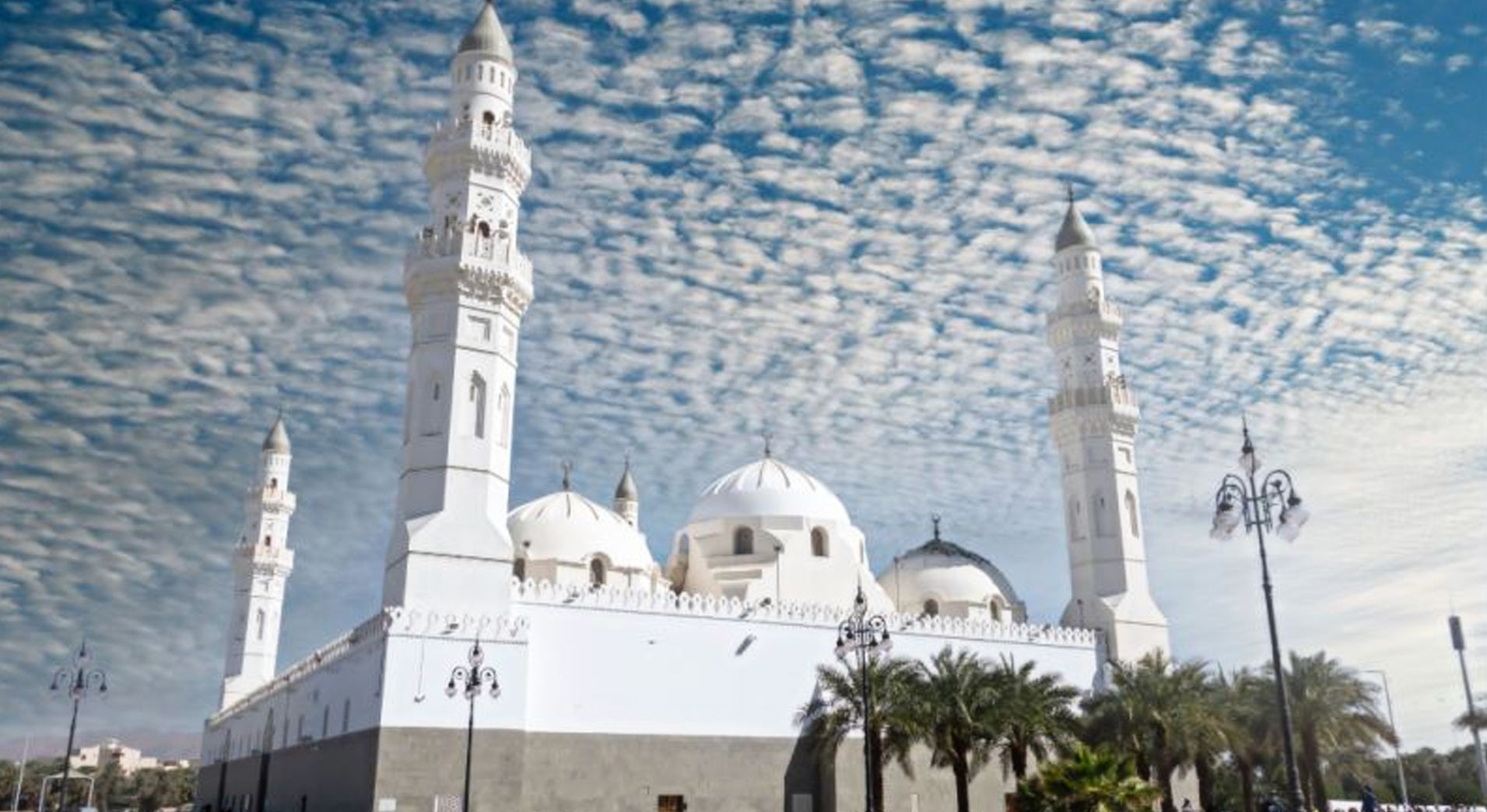
It’s about three miles from the Prophet’s Mosque in Madinah. You can walk there in forty minutes if the heat isn't killing you. Most people just take a taxi. But when you step inside Masjid e Quba Madinah, you aren't just entering a building with white domes and a cool marble floor. You're stepping into the very first foundation of an entire civilization. It’s quiet. It feels heavy with history, yet surprisingly airy. Honestly, if you visit Madinah and only stay within the marble courtyards of Al-Masjid an-Nabawi, you’re missing the heartbeat of how this whole journey started.
Most tourists think it's just another "ziyarah" stop. A quick photo, two rak'ahs of prayer, and back to the bus. They’re wrong.
Why Masjid e Quba Madinah isn't just "another" mosque
History is messy. Usually, the first of anything is long gone, buried under layers of newer concrete or lost to time. Not here. While the structure has been rebuilt many times—most notably by the Saudi government in 1986—the location is precise. This is the spot where the Prophet Muhammad (peace be upon him) stayed for several days after fleeing Makkah. He was a refugee. Let that sink in. The man who would change the world was sitting in this specific palm grove, waiting for Ali (may Allah be pleased with him) to catch up, and while he waited, he didn't just rest. He built.
The Prophet himself helped carry the stones. There are narrations describing him covered in dust, working alongside the companions. It wasn't a ceremonial "laying of the first stone" by a politician in a suit. It was grueling physical labor in the Hijazi heat.
The Umrah Secret
Here is the thing that really brings the crowds. There is a specific Hadith, authenticated in Sahih al-Bukhari and Sunan ibn Majah, that states if you perform wudu (ablution) at your home—or your hotel—and then go to Masjid e Quba Madinah and pray two units of prayer, you get the reward of a full Umrah.
Think about the logistics of that for a second.
A full Umrah usually involves hours of travel, putting on the Ihram, circling the Kaaba, and running between Safa and Marwa. It’s exhausting. But here, the Prophet (peace be upon him) gave a shortcut to the spiritual reward. He used to go there every Saturday. Sometimes he walked. Sometimes he rode his camel. He made it a habit. Because of this, the mosque is packed on Saturday mornings. If you want a moment of peace to actually think about the history, go on a Tuesday at 10:00 AM.
Architecture that tries to hide its size
When you look at the current building designed by Abdel-Wahed El-Wakil, it looks traditional. It doesn't scream "modernity" like some of the glass-and-steel structures in Riyadh. It uses a lot of white plaster and basalt stone. The cooling system is actually quite clever—it’s designed to handle thousands of people without feeling like a wind tunnel.
The mosque has four minarets. They stand 47 meters high. But the real star is the courtyard. It’s covered by a retractable shading system, though it’s different from the giant umbrellas at the Prophet's Mosque. There are 56 small domes scattered across the roof. It feels like a fortress of peace.
Interestingly, El-Wakil originally wanted to incorporate even more traditional cooling techniques, but the scale of modern pilgrimage requires some heavy-duty HVAC. Even so, the transition from the scorching sun of the parking lot into the dim, prayer-carpeted interior is a physical relief that borders on the spiritual.
Mistakes pilgrims make every single day
- The Wudu Trap: You have to perform wudu before you leave. If you wait until you get to the mosque's bathrooms to wash up, you technically don't meet the criteria for the Umrah reward mentioned in the Hadith. Most people forget this. They arrive, use the restroom, pray, and wonder why the locals are shaking their heads.
- The Saturday Rush: Everyone wants to follow the Sunnah of going on Saturday. It’s a beautiful sentiment, but if you’re looking for a deep, reflective experience, the crowds might distract you. The reward isn't only on Saturdays; that's just when the Prophet went most often.
- The Walk: There is a "Sunnah Walk" path connecting the Prophet's Mosque to Quba. It’s paved and lined with shops. If you do this in the summer, you will regret it. If you do it after Isha in the winter? It's one of the most beautiful walks in the world.
The deeper meaning of those first stones
Why did the Prophet (peace be upon him) build a mosque immediately? He hadn't even reached the center of Yathrib (which we now call Madinah) yet. He was in the suburb of Quba.
He was establishing an anchor.
In the seventh century, a mosque wasn't just a place to pray. It was a town hall. It was a courthouse. It was a shelter for the poor. By building Masjid e Quba Madinah, the Prophet was signaling that this new society wasn't going to be based on tribal lineages or who owned the most camels. It was going to be based on a shared space where everyone—rich, poor, local, or refugee—stood in the same line.
The Quran mentions this mosque in Surah At-Tawbah (9:108), referring to it as a mosque "founded on righteousness from the first day." That’s a heavy endorsement. It’s contrasting Quba with another mosque built nearby by some dissenters (Masjid al-Dirar) which was built to cause division. Quba was the opposite. It was the glue.
Realities of visiting in 2026
The area around the mosque has changed a lot. There are now high-end cafes and boutiques nearby. You can get a specialty latte three minutes away from where the first stones of Islamic history were laid. Some people find that jarring. Others see it as the natural evolution of a living city.
The expansion plans for Madinah are massive. The government intends to increase the capacity of Quba significantly because, right now, it can only hold about 20,000 people. During Ramadan, that’s nothing. They want to make it hold over 50,000. This means more construction, more cranes, and eventually, more marble. If you want to see the "older" version of the 1980s reconstruction, go soon.
Moving beyond the surface
If you really want to "feel" Masjid e Quba Madinah, you have to look past the white paint. Think about the Ansar—the locals of Madinah—who stood on the volcanic rocks of the Harrah, looking toward Makkah, waiting for a glimpse of a camel on the horizon. They were nervous. They had invited a man who was wanted dead by the most powerful tribe in Arabia. When he finally appeared, they sang. They welcomed him here, in Quba.
The mosque is a monument to that hospitality. It’s a monument to the moment a group of people decided to risk everything for a new idea.
Practical Advice for the Modern Traveler
- Timing: Aim for "Duha" time. This is about 20 minutes after sunrise. The light hitting the white domes is incredible for photos, and the temperature is still manageable.
- Transportation: Use apps like Uber or Careem. Taxis near the haram will try to overcharge you, sometimes asking for 50 Riyals for a trip that should cost 15.
- Etiquette: It's a busy place. If you see someone elderly struggling to find a spot, give up yours. The spirit of Quba is the spirit of the Ansar (the helpers).
- The Dates: The area around Quba is famous for its palm groves. If you see locals selling dates near the mosque entrance, they are often fresher than the ones in the giant tourist markets. Look for the "Rutab"—the semi-ripe, soft ones that melt in your mouth.
Actions to take before you visit
Don't just show up. To get the most out of Masjid e Quba Madinah, you need a plan that respects both the spiritual and historical weight of the site.
First, read the Seerah (prophetic biography) specifically regarding the Hijrah. Knowing the names of the people who lived in Quba, like Kulthum ibn al-Hidm, makes the site three-dimensional. It stops being a building and starts being a home.
Second, check the local prayer times. The mosque closes briefly for cleaning at certain times of the night, though it is generally open for the five daily prayers.
Third, if you are physically able, try the walking path from the Prophet's Mosque at least once, but do it at night. The path is called "Darb al-Sunnah." It is well-lit, safe, and gives you a sense of the actual distance the Prophet traveled.
Finally, ensure your wudu is performed at your place of stay if you are seeking the reward mentioned in the traditions. Carry a small water bottle, wear comfortable shoes, and keep your phone in your pocket during the prayer. The beauty of Quba is best captured with the eyes first, and the camera second.
The expansion of the mosque is ongoing, so be prepared for some scaffolding or diverted walkways. Regardless of the construction, the essence remains. It is the "Mosque of Piety," and it continues to serve as the gateway to the city of the Prophet.