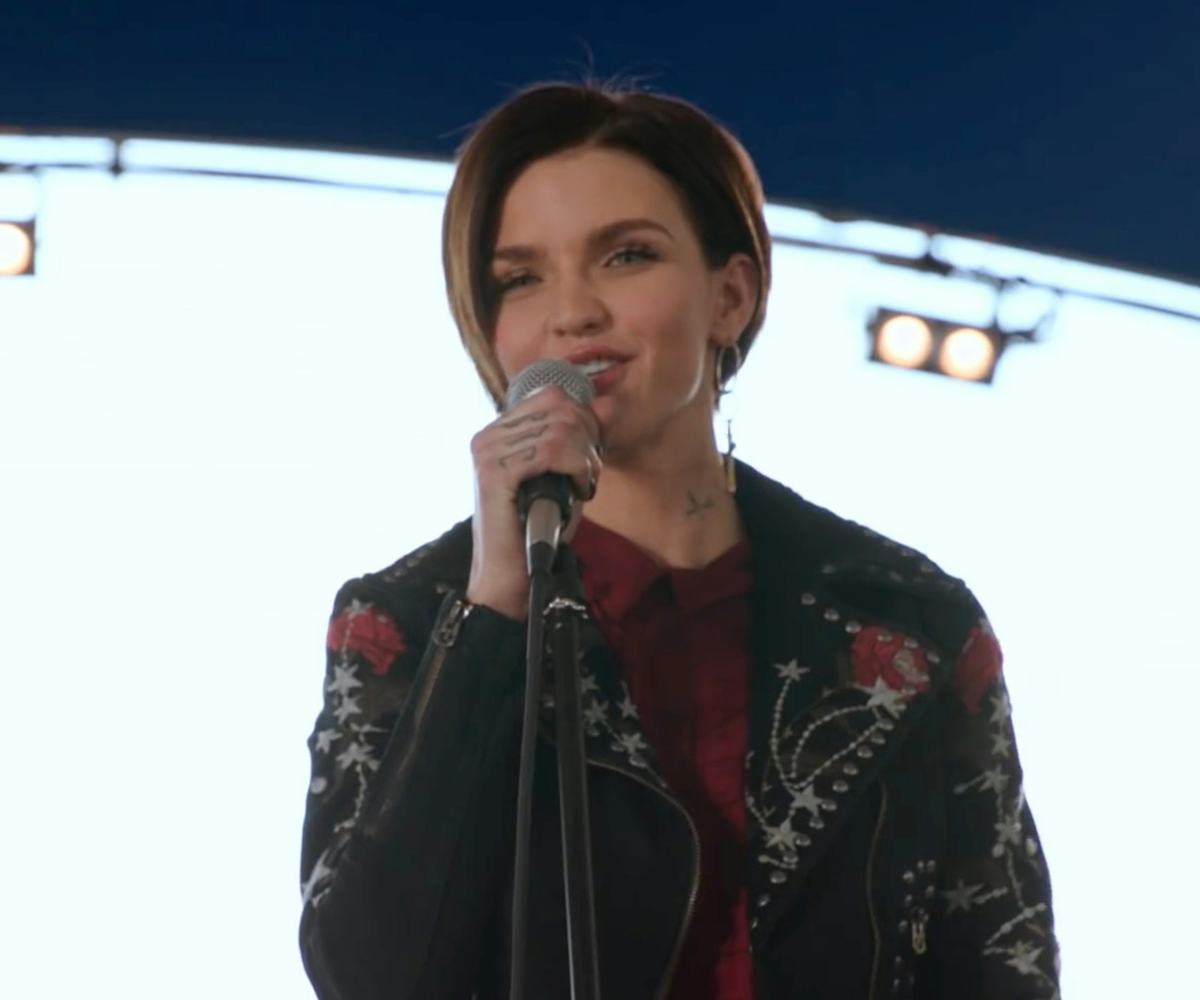
You probably remember the visual: a leather-clad, tattooed rockstar strumming a guitar with more confidence than the entire Barden Bellas lineup combined. When people talk about Ruby Rose Pitch Perfect appearances, they aren’t talking about some background extra. They're talking about Calamity.
Calamity was the lead singer of Evermoist. Yeah, that was actually the name of the band. It’s one of those movie details that feels like a fever dream now, but in 2017’s Pitch Perfect 3, it was the central antagonistic force. Ruby Rose didn't just show up; she basically hijacked the aesthetic of the final film in the trilogy.
Honestly, the third movie was a bit of a chaotic mess. It pivoted from college acapella competitions to a weird USO tour/spy thriller hybrid. But amidst the exploding boats and DJ Khaled cameos, Ruby Rose stood out because she represented something the Bellas couldn't touch: actual instrumental talent. In a franchise built on "mouth music," seeing a character walk in with a Gibson Flying V was a total gear shift.
The Role of Calamity and Evermoist
Ruby Rose played Calamity, the frontwoman of a four-piece all-female rock group. They were the "villains" of the USO tour, though their villainy mostly consisted of being cooler, more professional, and having actual instruments.
The Bellas, led by Beca (Anna Kendrick) and Fat Amy (Rebel Wilson), were struggling with post-college identity crises. Then they walk into a rehearsal room and see Evermoist. It’s a classic cinema trope—the underdog protagonists getting intimidated by the polished pros. Ruby Rose played that arrogance perfectly. She didn't have to do much; her presence alone did the heavy lifting.
If you look back at the "Riff Off" in the third film—which is a staple of the series—it’s fundamentally different. Usually, it's just voices. This time, Evermoist breaks the "rules" by playing their own instruments. Calamity looks at Beca and says, "We play instruments. We also use our voices. It’s called being a band." It was a meta-commentary on the franchise itself. It pointed out that the Bellas were, in a way, limited by their own genre.
Why Ruby Rose Was Cast
By 2017, Ruby Rose was everywhere. She’d just come off a massive breakout in Orange Is the New Black and was the "it" person for action-heavy roles like John Wick: Chapter 2 and xXx: Return of Xander Cage.
Casting her in a musical comedy was a smart move. It brought in a different demographic. It added an edge to a franchise that was arguably getting a bit too "Disney" in its late stages. She brought a specific, androgynous rock-star energy that the series lacked. Plus, she actually has a background in music and DJing, so she didn't look awkward holding a guitar, even if she wasn't shredding the solos herself.
The "Zombie" Cover and the Evermoist Sound
Let's talk about the music. Evermoist’s big moment was their cover of "Zombie" by The Cranberries. It was moody. It was dark. It was the complete opposite of the Bellas' "Freedom! '90" or "Cheap Thrills."
- Vibe: Grungy, pop-rock.
- The Look: High-fashion punk.
- The Conflict: It forced Beca to realize she might want a solo career.
The Ruby Rose Pitch Perfect character was the catalyst for the entire ending of the trilogy. Calamity wasn't just a rival; she was a mirror. Beca saw in Calamity what she could be if she stopped playing it safe with her friends. That's a lot of narrative weight for a character who mostly just smirks and plays power chords.
People often forget that the music in these movies is heavily produced. While the Bellas' tracks are layered with dozens of vocal tracks to create that "wall of sound," Evermoist’s tracks were stripped back. They used real drums and distorted guitars. It made the Bellas' acapella sound thin in comparison, which was exactly the point of the script.
Is Ruby Rose Actually Singing?
This is the big question everyone asks. Yes and no.
In the world of high-budget musical comedies, almost everything is pre-recorded in a studio. Ruby Rose did record her vocals for the soundtrack. However, in the final mix, her voice is blended with professional session singers to ensure that "radio-ready" pop-rock sound.
It’s the same thing they did with the rest of the cast. While Anna Kendrick and Hailee Steinfeld are legit singers, the "Pitch Perfect" sound is a specific brand of hyper-polished audio. Rose’s voice has a lower register, which provided a nice contrast to the high-energy soprano and alto ranges of the Bellas.
Misconceptions About Ruby Rose in the Trilogy
Some fans think Ruby Rose was in all three movies. She wasn't. She was strictly a Pitch Perfect 3 addition.
There's also a weird rumor that she was supposed to be a love interest for one of the Bellas. While the internet (especially Twitter and Tumblr) shipped Calamity and Beca hard, there was never a scripted romantic subplot. The "chemistry" people saw was mostly just two talented performers playing off each other's competitive energy.
Another point of confusion is whether Evermoist was a real band. They weren't. The other members were played by Andy Allo (who is a fantastic musician in her own right), Venzella Joy, and Hannah Fairlight. They were a "supergroup" assembled specifically for the film.
The Cultural Impact of the Character
Why does Ruby Rose Pitch Perfect still trend? Honestly, it's about representation and style. Calamity was one of the few explicitly "cool" characters in a series that leaned heavily into "nerd culture."
For a lot of queer fans, seeing Ruby Rose in a major musical franchise was a huge deal. Even if her character was technically an antagonist, she wasn't a villain in the traditional sense. She didn't have an evil plan. She was just better at her job than the protagonists were at theirs for most of the movie.
The fashion also left a mark. The "Evermoist look"—distressed denim, heavy eyeliner, leather vests, and combat boots—became a shorthand for the 2017 "alternative-lite" aesthetic that dominated Pinterest at the time.
Behind the Scenes: The USO Experience
The filming of the USO scenes wasn't just done on a soundstage in Atlanta. They actually filmed on real military bases. Rose has mentioned in interviews that performing for actual troops gave those scenes a different energy.
The "Riff Off" scene, which took place in a hangar, was notoriously long to film. You have dozens of actors, multiple bands, and a lot of choreographed movement. Rose had to look effortless while essentially being a human prop for Beca’s character development.
What the Critics Said
Critics were... let's say "mixed" on Pitch Perfect 3. Many felt the plot was too thin. However, almost every review mentioned the bands. Evermoist was often cited as a highlight because they broke the monotony of the acapella format.
Elizabeth Banks, who produced the film and directed the second one, has spoken about wanting to "elevate the stakes." Bringing in a "real" band like the one led by Ruby Rose was their way of doing that. It forced the Bellas to prove that they still mattered in a world of "real" music.
Tracking the Career Path Since Pitch Perfect
Since her stint as Calamity, Ruby Rose’s career has been a rollercoaster. She became Batwoman, then left the show under a cloud of controversy and injury reports. She’s moved more into the independent action movie space.
But for a specific generation of fans, she’s still that rockstar from the USO tour. It was a moment in time where pop-punk, acapella, and mainstream Hollywood converged in a very strange, very loud way.
Technical Details: The Gear and the Sound
If you're a guitar nerd, you might have noticed the instruments. Calamity’s band didn't just use random props.
- The Guitar: That iconic Flying V wasn't just for show; it's a staple of rock history.
- The Pedals: If you look closely at the stage floor during the "Zombie" performance, there are actual pedalboards.
- The Arrangement: The "Zombie" arrangement was handled by Christopher Lennertz and Bill Sherman, who had to make sure a rock band didn't completely drown out the acapella groups during the mashups.
Final Take on the Legacy of Evermoist
Does the movie hold up? Maybe not as well as the first one. But the Ruby Rose Pitch Perfect crossover remains a fascinating artifact of late-2010s cinema. It was the peak of "Ruby Rose Mania" and the swan song of a franchise that defined a decade of musical movies.
If you’re revisiting the series, pay attention to the scene where Calamity first speaks to Beca. It’s not just a trash-talk moment. It’s a transition of power. It’s the moment the franchise admitted that maybe, just maybe, singing without instruments isn't the only way to be a star.
Actionable Steps for Fans and Creators
If you're looking to dive deeper into the world of movie music or Ruby Rose’s filmography, here’s how to do it effectively:
- Listen to the Soundtrack: Go beyond the movie clips. The studio versions of "Zombie" and "How Du You Feel" (another Evermoist track) show the actual vocal layers Rose and her bandmates provided.
- Check out Andy Allo: If you liked the "band" vibe, Ruby Rose’s co-star Andy Allo is a protégé of Prince and has an incredible solo discography that's much more soulful than the movie's rock sound.
- Analyze the Riff-Off Structure: For aspiring musicians or filmmakers, compare the Riff-Off in the first movie to the third. Look at how the inclusion of instruments changes the camera work and the editing pace.
- Watch the "Making Of" Featurettes: The Blu-ray and digital extras for Pitch Perfect 3 have specific segments on the "New Rivals." They show the rehearsal process for the bands, which was actually quite intensive compared to the Bella’s choreography.
The movie might be a lighthearted comedy, but the effort put into making Evermoist look and sound like a legitimate threat to the Bellas was a serious undertaking by the music department. It remains one of the most distinctive "rival" groups in musical movie history.