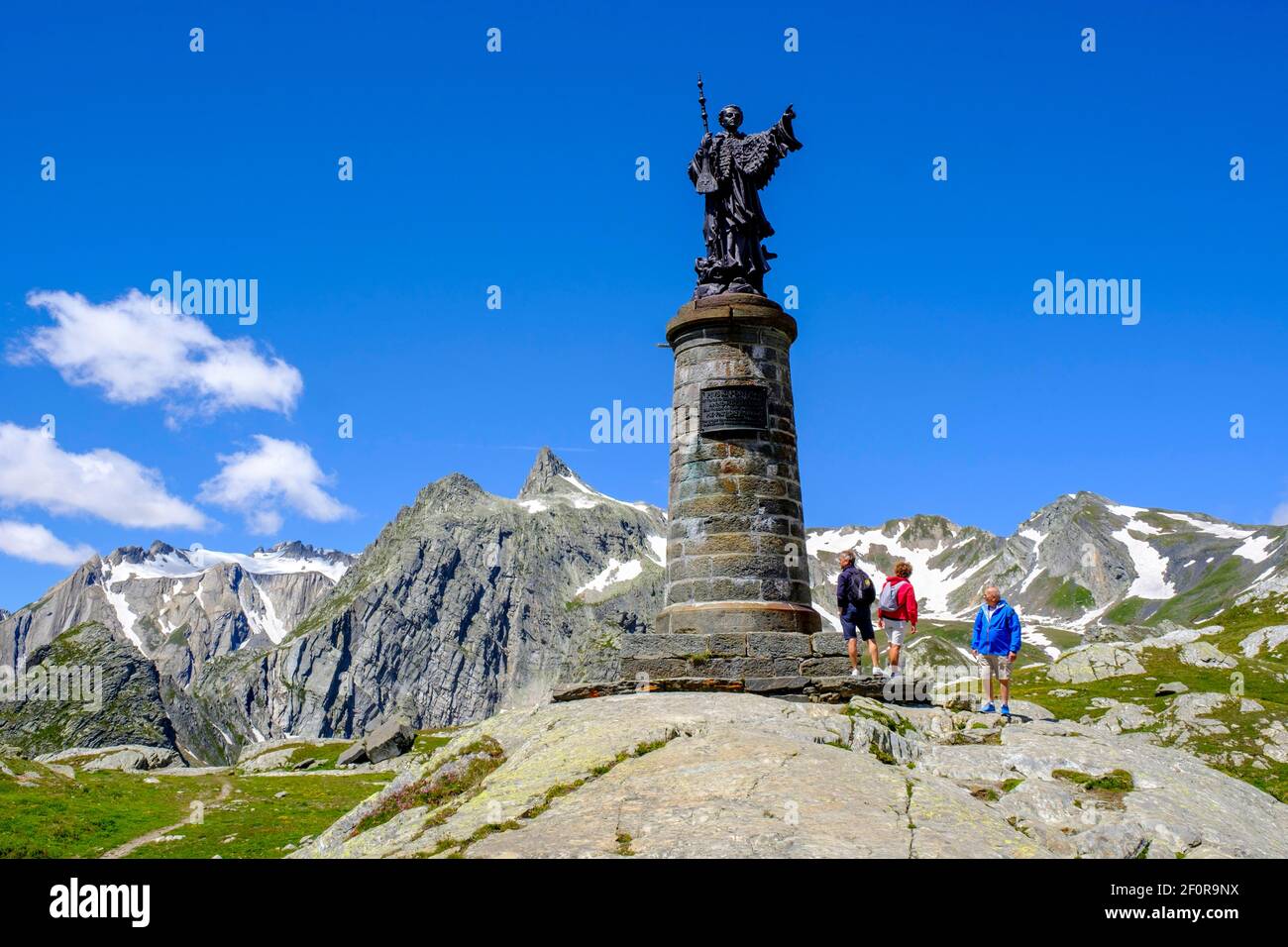
You’ve probably heard the name. Usually, it’s associated with a massive dog carrying a brandy barrel around its neck in the Alps. But the real Saint Bernard of Clairvaux didn't have four legs, and honestly, he was way more influential than a rescue pup. We’re talking about a man who basically acted as the unofficial Pope, the king-maker of Europe, and the mystical heart of the Cistercian order all at once. He was a powerhouse.
He wasn't just some monk hiding in a drafty cell. Bernard was everywhere.
The Cistercian Explosion and the Wild Success of Clairvaux
In 1112, Bernard showed up at the gates of Cîteaux. It wasn't a glamorous place. The monks there were struggling, trying to live a life of "apostolic poverty" that was honestly just a bit too hardcore for most people at the time. But Bernard didn't come alone. He brought thirty of his relatives with him. Think about that for a second. Most people struggle to get their family to agree on a restaurant for dinner. Bernard convinced his brothers and uncles to take a vow of silence and live on leeks and prayer.
That’s the kind of charisma we’re dealing with here.
Within three years, he was sent out to start a new branch. He chose a spot called the "Valley of Bitterness." Not a great marketing name, right? He renamed it Clara Vallis—Clairvaux, the Bright Valley. From there, the Cistercian order exploded. When he started, there were a handful of houses. By the time he died in 1153, there were 343 Cistercian monasteries spread across Europe. He personally founded 68 of them.
The growth was insane. It was the medieval equivalent of a tech startup going global in months. But instead of software, they were exporting a very specific, stripped-down version of Benedictine life. They hated the flashy, gold-plated excess of the Cluniac monks. Bernard wanted grit. He wanted manual labor. He wanted the architecture to be simple, which ironically led to some of the most beautiful, minimalist Gothic structures ever built.
Why He Was Basically the 12th Century's Influencer-in-Chief
People listened to him. It didn’t matter if you were a peasant or the King of France. When the Church was split by a massive schism in 1130—two guys both claiming to be the rightful Pope—it was Saint Bernard of Clairvaux who decided the winner. He backed Innocent II. Why? Because Bernard felt he was the better man for the job. He spent the next eight years traveling across Europe, convincing everyone else to agree.
He won.
He was also the primary mind behind the Knights Templar. He didn't just support them; he wrote their rule. Imagine a monk writing the operating manual for an elite military force. That was Bernard. He gave them a theological backbone, arguing that "fighting for Christ" wasn't a contradiction. It was a radical shift in how the medieval world viewed the "Christian soldier."
But he wasn't always on the right side of history, and it's important to be honest about that. The Second Crusade was largely his fault. He preached it with such fiery passion that he claimed cities were being emptied of their men. When the crusade ended in a total, bloody disaster, the blowback was massive. People were furious. Bernard, ever the mystic, blamed the crusaders’ own sins for the failure rather than his own recruitment tactics. It’s a complicated legacy.
The Mystic Who Hated Fancy Art
If you walk into a Cistercian abbey today, like Fontenay in France, you’ll see his fingerprint. No stained glass with complicated stories. No weird statues of monsters or saints. Just light and stone.
Bernard had this famous beef with Suger, the Abbot of St. Denis. Suger loved gold and jewels; he thought they reflected the light of God. Bernard thought that was a distraction. He famously asked, "What has all this gold to do in the sanctuary?" He felt that monks, who were supposed to be focused on the internal life, shouldn't be staring at "beautiful deformities" on the walls.
This focus on the "internal" is what made his writing so sticky. His Sermons on the Song of Songs are legendary in theological circles. He didn't see the Bible as just a history book. He saw it as a love letter. He talked about the soul’s relationship with God in terms that were, frankly, pretty steamy for a monk. He used the language of brides and grooms, kisses and embraces. It was "affective piety," and it changed the way Europeans thought about God—shifting from a distant, scary Judge to a personal, intimate Lover.
A Man of Contradictions
He was a peace-weaver who started a war.
He was a hermit who couldn't stop getting involved in politics.
He was a man who loved silence but wrote thousands of letters.
He was also a bit of a bulldog when it came to intellectual rivals. Take Peter Abelard. Abelard was the rockstar philosopher of Paris—brilliant, arrogant, and fond of using logic to deconstruct faith. Bernard hated that. He thought you couldn't "logic" your way to God; you had to love your way there. He hounded Abelard, eventually getting his teachings condemned at the Council of Sens in 1140. It was a clash of titans: the cold logic of the university versus the fiery mysticism of the monastery. Bernard's victory ensured that for a long time, the heart took precedence over the head in Western spirituality.
The Practical Impact of the "Bernardine" Way
The Cistercians weren't just praying all day. They were the masters of medieval engineering. Because they settled in remote valleys, they had to figure out water management. They built dams, redirected rivers, and created advanced irrigation systems.
- They pioneered large-scale wool production in England.
- They perfected iron-working techniques that were arguably the best in the world at the time.
- They turned "wasteland" into highly productive agricultural hubs.
When you look at Saint Bernard of Clairvaux, you aren't just looking at a guy in a white habit. You're looking at the architect of a socio-economic revolution. He proved that a religious movement could be a massive economic engine if it was disciplined enough.
What You Can Actually Learn From Him Today
It’s easy to dismiss a 12th-century monk as irrelevant to the modern world, but that’s a mistake. Bernard’s life offers some pretty sharp insights into leadership and focus.
First, the power of a "minimalist" brand. In an age of Cluniac excess, the Cistercian simplicity was what drew people in. There’s a lesson there about cutting the noise.
Second, the weight of words. Bernard’s letters (and he wrote a lot of them) were his primary tool of power. He knew how to frame an argument to make it feel like a divine mandate. Whether he was writing to the Duke of Lorraine or a straying monk, his tone was always calibrated for maximum impact.
Third, the danger of your own hype. The failure of the Second Crusade is a permanent asterisk on his record. It’s a reminder that even the most "enlightened" leaders can get blinded by their own rhetoric and lead people into a meat grinder.
How to Engage With the History
If you want to actually "get" Bernard, don't just read a Wikipedia summary.
- Visit a Cistercian site. If you're ever in Burgundy, go to Clairvaux or Fontenay. Stand in the cloister. The silence and the specific way the light hits the stone tell you more about Bernard’s theology than a textbook ever could.
- Read his letters. They are surprisingly readable. You’ll see him being manipulative, kind, angry, and deeply vulnerable. It humanizes the "saint."
- Look at the architecture. Study the transition from Romanesque to Gothic. Bernard was right at the center of that shift, pushing for a style that emphasized height and light over heavy, dark walls.
Saint Bernard of Clairvaux died exhausted. He had spent his final years trying to keep the peace and failing to reconcile his love for the monastery with the world's constant demand for his presence. He was buried at Clairvaux, but his legacy is baked into the very soil of Europe. He taught the West how to organize, how to build, and—most importantly—how to feel.
To truly understand the medieval mind, you have to start with the man who lived in a "Bright Valley" but cast a shadow over the entire continent. He wasn't perfect, and he definitely wasn't quiet, but he was undeniably one of the most effective human beings to ever walk the earth.
Actionable Next Steps:
- Audit your "mental clutter": Bernard’s hatred of "distractions" in the monastery is a direct ancestor to modern digital minimalism. Identify three "ornaments" in your life that are actually just distractions from your primary work.
- Read "On Loving God": It’s his most accessible work. It’s short, punchy, and explains his four degrees of love—a framework that still holds up in psychological circles today.
- Explore Cistercian "Technology": Research the Cistercian influence on the European wool trade or their hydraulic engineering. It’s a fascinating look at how "spiritual" people changed the material world through sheer organizational grit.