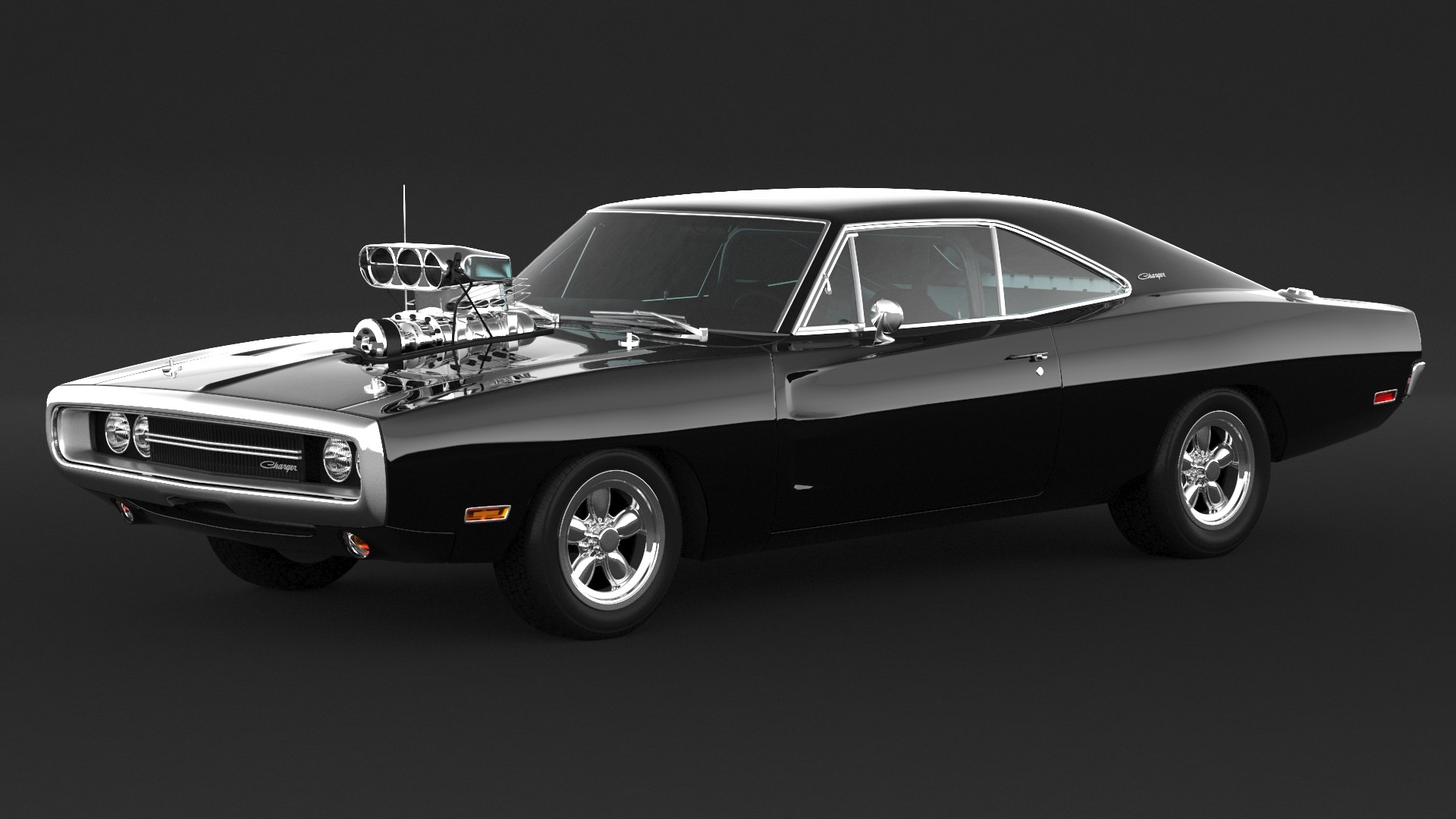
Dominic Toretto’s 1970 Dodge Charger R/T isn’t just a movie car. It’s a character. Honestly, at this point in the Fast & Furious franchise, that blacked-out Mopar has more screen presence and emotional weight than half the human cast. It represents a specific era of cinema where practical stunts still felt dangerous and the smell of burnt rubber was almost palpable through the screen. You’ve seen it wheelie. You’ve seen it get crushed by a semi-truck. You’ve seen it somehow survive being dropped out of a plane. But if you look past the Hollywood magic, the story of the Fast and Furious Charger is actually a mess of mechanical contradictions, multiple builds, and some very clever camera tricks that fooled us all back in 2001.
Most people think there’s just "the" car. There isn't.
For the original The Fast and the Furious, the production team didn't just have one pristine 1970 Charger sitting in a garage. They had a fleet. Specifically, they used several 1968, 1969, and 1970 models, all modified to look like the iconic '70 version with the continuous chrome grille and the buried taillights. It’s a bit of a Frankenstein situation. The "hero" car—the one used for close-ups where Vin Diesel looks brooding—was a legitimate 1970 Dodge Charger. But the ones doing the heavy lifting? Those were sacrificial lambs.
The 900 Horsepower Myth and the Blown Hemi
"My father and I, we built it," Dom tells Brian O'Conner while standing in that dimly lit garage. He claims the car puts out 900 horsepower and ran a 9-second flat quarter-mile at Palmdale. It’s a legendary piece of dialogue. It sets the stakes. But here’s the kicker: the massive BDS 8-71 Roots-style supercharger poking through the hood in the first movie? It wasn't even functional.
Yeah, it’s a bit of a letdown.
For the filming of the original movie, the production crew couldn't get the blower to work reliably with the engine setup they had for the stunt sequences. If you look closely at some of the high-speed runs, the butterflies on top of the scoop are actually being operated by a hidden cable. They were manually flipped open to make it look like the engine was gasping for air. Underneath that chrome-plated eye candy was usually a standard Chrysler 440 Magnum V8. Don’t get me wrong, a 440 is a beast of a motor, but it’s not the world-ending 900-hp monster the script promised.
The sound was also a lie. The aggressive, high-pitched whine you hear in the theater? That wasn't the Dodge. Sound editors actually layered in recordings of a different car to give it that "supercharged" scream because the actual prop car sounded a bit too... normal.
Why the Wheelie Was (Mostly) Fake
The climax of the first film is etched into every gearhead's brain. Dom launches the Charger, the front wheels lift three feet off the ground, and the chassis twists under the sheer torque. It’s glorious. It’s also physically impossible for that specific car to do that on a street surface without wheelie bars or a massive amount of weight in the trunk.
To pull off that shot, the stunt team used "wheelie stands." These were hydraulic rams hidden behind the front wheels. When the car launched, the rams fired, pushing the nose into the air. If you watch the scene in slow motion, you can actually see the metal bars briefly before the camera cuts away. Also, if a car actually had enough torque to lift the front end like that while spinning the rear tires, it wouldn't be moving forward that slowly. It’s a physics nightmare, but man, does it look cool on a giant screen.
The Evolution of the Charger Through the Decades
As the franchise shifted from street racing to international heist-fests, the Fast and Furious Charger had to evolve. It couldn't just be a drag car anymore. It needed to be a tank.
By the time we got to Fast Five, the Charger was back, but it looked different. It was matte black. It looked meaner. This version was built by Dennis McCarthy and his team at Vehicle Effects. McCarthy is basically the unsung hero of the franchise; he’s the guy who actually builds these things to survive the punishment. For Fast Five, they built a "stunt" version of the Charger that used a custom off-road chassis because they needed it to bash through walls in Rio de Janeiro.
Then came the "Off-Road" Charger in Furious 7.
This is where things got really wild. They took a 1970 body and dropped it onto a custom trophy-truck-style tubular chassis. Long-travel suspension, massive rugged tires, and a spare tire rack in the back. It was built to be dropped out of a C-130 Hercules transport plane. Well, they actually dropped several cars out of a plane for that shot. Most of them didn't survive the landing, despite the parachutes.
The Mid-Engine Masterpiece
If you want to talk about the peak of the Fast and Furious Charger lineage, you have to talk about the "Hellacious" Charger from F9. This is the one that really divided the purists.
It’s a mid-engine build.
Basically, they took a 1968 Charger body, widened it significantly (we’re talking a massive wide-body kit), and shoved a 6.2-liter Hellcat V8 behind the driver’s seat. To make it work, they used a Graziano transaxle from a Lamborghini Gallardo. It’s a mid-engine, manual-shift, 707-horsepower American muscle car with Italian guts. Unlike the car in the first movie, this one was a functional masterpiece. SpeedKore Performance Group actually built a road-going version of this for Vin Diesel, and the engineering required to get a Hellcat engine to sit mid-ship in a 50-year-old Dodge frame is staggering.
Real World Values: Can You Actually Buy One?
If you're looking to build a replica of the Fast and Furious Charger, I hope you have deep pockets. The market for second-generation Chargers (1968-1970) has absolutely exploded, partially because the movie franchise kept destroying them.
Back in the late 90s, you could pick up a decent 1970 Charger for about $15,000. Today? A "project" car that’s mostly rust and hope will cost you $40,000. A clean, running R/T model? You’re looking at $100,000 to $150,000. If you want a movie-accurate build with a real 6-71 blower and the correct interior, you could easily sink $250,000 into the project.
There is a huge community of "clone" builders. Sites like DodgeCharger.com are filled with threads where fans argue over the exact shade of black paint used in the first movie (it was actually a fleet black, nothing fancy) or which specific roll cage design was used in the stunt cars.
Common Misconceptions About the Build
- The Year: People often confuse the '68, '69, and '70. The '70 is distinguished by that wrap-around chrome bumper/grille. The '68 has round taillights. The '69 has the split grille. Dom’s car is officially a '70, but as mentioned, the movies used all three interchangeably with parts swaps.
- The Transmission: In the movies, Dom is always slamming through gears. However, most of the stunt cars were automatics. Why? Because it’s way easier for a stunt driver to focus on not dying if they don't have to worry about a clutch pedal while sliding sideways at 60 mph.
- The Interior: The original car had a very stripped-down, race-focused interior with a lot of sheet metal. In reality, that would be incredibly loud and uncomfortable to drive for more than five minutes.
The Cultural Impact: Why This Specific Car?
Why didn't Dom drive a Mustang? Or a Camaro?
The choice of the 1970 Dodge Charger was deliberate. The Charger is the ultimate "villain" car of the muscle car era. It’s big. It’s heavy. It looks like it wants to punch you in the face. When the first Fast and Furious was being developed, the producers wanted a car that contrasted with the high-tech, high-RPM Japanese tuners like Brian’s Supra or the Eclipse.
The Fast and Furious Charger represented "old school" American brawn. It was the antithesis of the "tuner" culture the movie was exploring. It was a bridge between the classic car movies of the 60s and 70s—like Bullitt or Vanishing Point—and the new wave of 21st-century action cinema. It gave the movie an anchor in reality, even as the stunts became increasingly absurd.
Actionable Steps for Mopar Enthusiasts
If you’re inspired by the Fast and Furious Charger and want to get into the world of classic Mopar, you need a plan. You can't just jump into a '70 Charger without knowing what you're getting into.
- Don't start with a Charger. If you don't have $50k to play with, look at the Dodge Coronet or the Plymouth Satellite. They share the same "B-Body" platform as the Charger. They have the same engines, the same suspension, and the same aggressive stance, but they cost a fraction of the price because they weren't in a movie.
- Learn the "B-Body" Rust Points. These cars are notorious for rotting in the trunk pans and the rear window channels. If you find a cheap Charger, check those spots first. If the frame rails are gone, walk away.
- Modernize the Guts. If you actually want to drive your car, don't build a 900-hp drag monster. Look into "Restomodding." Drop in a modern 5.7L or 6.4L Hemi crate engine. You get the classic look of Dom’s car with the reliability of a modern Challenger.
- The Blower Issue. If you must have the supercharger sticking out of the hood, be prepared for visibility issues. It is genuinely hard to see the right side of the road with an 8-71 blower in your line of sight. Most movie cars had the blower mounted slightly lower or used smaller scoops for actual driving scenes.
The Fast and Furious Charger is more than a movie prop; it's the reason a whole generation of kids knows what a "Blower" is. It’s the reason Dodge is still selling Hellcats today. Even if the physics are faked and the engines are sometimes swapped, the soul of the car remains. It’s about the "ten seconds or less" philosophy.
Whether it's the original blown black beauty or the mid-engine monster from the later films, the Charger remains the undisputed king of the franchise. It’s the only car that can share the screen with Vin Diesel and actually make him look like the sidekick. If you're going to chase that dream, do it for the right reasons. Do it because you love the metal, the noise, and the history. Just maybe don't try to jump it over a moving train. That part... probably won't end well for the car.