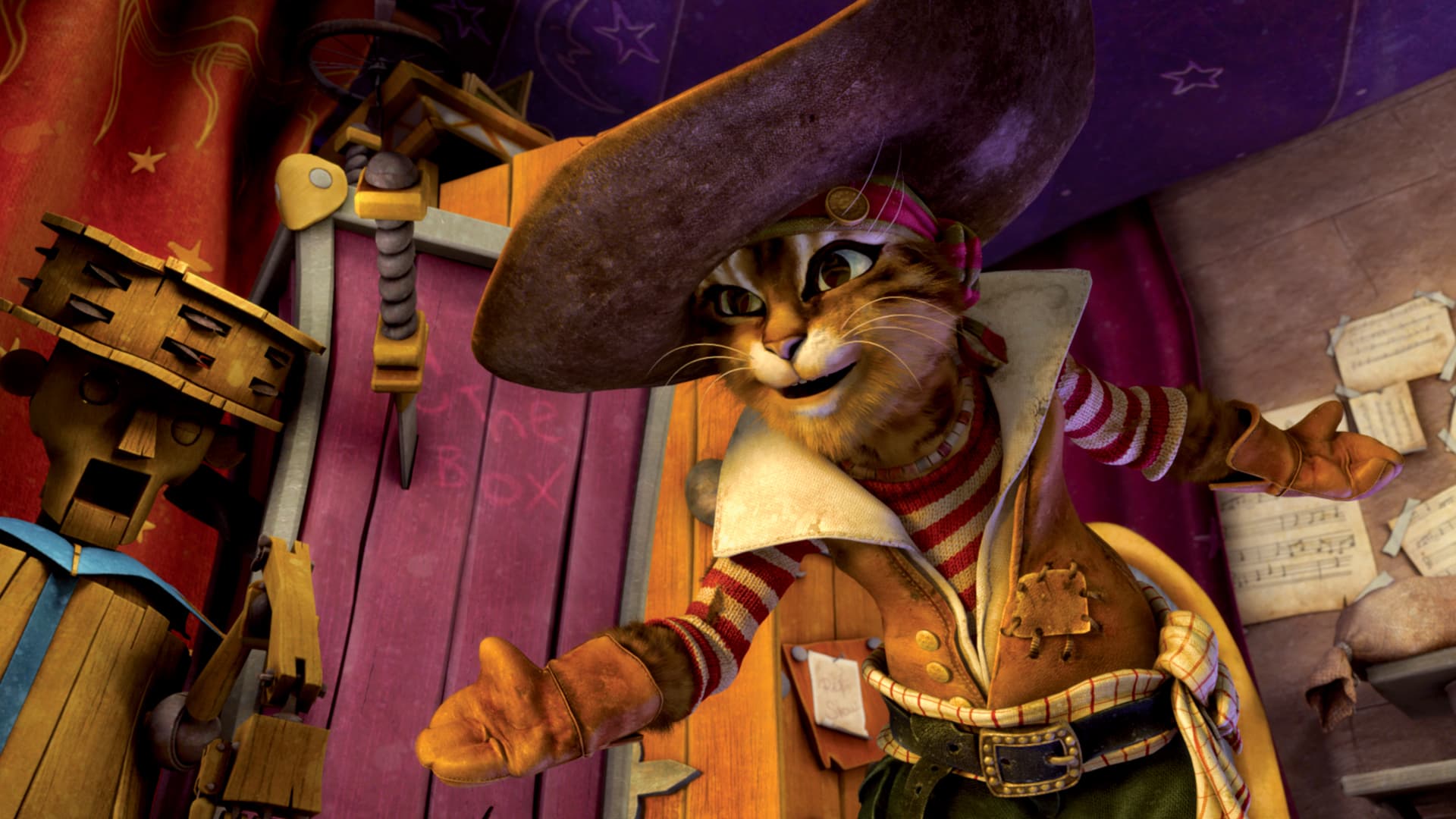
You probably think of a ginger tabby in leather boots with the voice of Antonio Banderas. He’s charming, he’s a rogue, and he’s a DreamWorks icon. But the true history of Puss in Boots doesn't start with a Spanish accent or a movie studio in Glendale. It starts with a dead miller, a very clever cat, and a disturbing amount of gaslighting.
Honestly, the original story is less about being a hero and more about being a high-level con artist. There’s no "Leche" or big-eyed begging here. Instead, we have a feline who basically blackmails a group of peasants into lying to a king or face being "chopped into mincemeat." It’s gritty. It’s weird. And it’s centuries old.
Where the Boots Actually Came From
Before the 1697 version most of us know, there was a guy named Giovanni Francesco Straparola. Around 1550, he published The Facetious Nights. It’s one of the first times we see this specific trope: a clever animal helping a poor owner. But get this—the cat wasn't even wearing boots yet. In Straparola's "Costantino Fortunato," the cat is actually a fairy in disguise. There’s no footwear. Just pure, unadulterated magical manipulation.
Then comes Giambattista Basile in 1634. He wrote Cagliuso. In this version, the cat is a female. She’s incredibly smart and helps her owner, Cagliuso, marry a princess. But the ending is a total gut-punch. Cagliuso promises the cat a gold coffin when she dies. To test him, the cat pretends to be dead. Instead of getting a coffin, she hears Cagliuso tell his wife to just grab her by the legs and toss her out the window.
The cat wakes up, screams at him for being an ungrateful jerk, and runs away. No happy ending. No "happily ever after." Just a lesson on how people are generally terrible.
Charles Perrault and the Marketing of a Legend
The true history of Puss in Boots as we recognize it today really solidified in 1697. Charles Perrault, a French author, included Le Maître Chat ou le Chat Botté in his collection Histoires ou contes du temps passé. Perrault is the one who gave the cat the boots. Why boots? Because in 17th-century France, boots were a symbol of status. They were expensive. They meant you were a gentleman, a traveler, someone with a purpose.
By putting boots on a cat, Perrault was making a visual joke that his audience would have immediately understood. It was absurd. It was like seeing a dog in a tuxedo today.
Perrault’s version is the blueprint. A miller dies and leaves his three sons his mill, his donkey, and his cat. The youngest son gets the cat and thinks he’s going to starve. The cat, sensing a mid-life crisis, asks for a pair of boots and a bag.
What follows is a masterclass in social engineering. The cat catches a rabbit, gives it to the King, and says it’s a gift from the "Marquis of Carabas." There is no Marquis of Carabas. The cat just made it up. He continues this for months. Eventually, he fakes a drowning incident, steals some clothes for his master, and tricks an ogre into turning into a mouse so he can eat him.
The cat wins. The master gets the castle. The King is impressed. Everyone is happy, except for the ogre who is currently being digested.
The Darker Subtext You Probably Missed
We tend to sanitize these things for kids. But if you look at the true history of Puss in Boots, it’s a story about the "New Man" of the 17th century. Perrault was writing during a time when the French middle class was starting to rise. Social mobility was becoming a thing.
The cat represents "industry" and "wit." He’s the ultimate self-made... animal.
Scholars like Maria Tatar and Jack Zipes have pointed out that Puss is essentially a "trickster" figure. In folklore, tricksters aren't necessarily "good." They are amoral. They do what works. Puss uses deception, threats of violence, and literal consumption of his enemies to move up the social ladder.
Think about the peasant scene. Puss runs ahead of the King’s carriage and tells the mowers in the field that if they don't tell the King the land belongs to the Marquis of Carabas, they will be "chopped as small as herbs for the pot." That’s not a hero. That’s a mob boss.
Why the Boots Matter More Than the Cat
In the early illustrations by Gustave Doré, the boots are massive. They look heavy. They look real. This is important because it grounds the fantasy. The boots are the bridge between the animal world and the human world. Without the boots, he's just a cat that talks. With the boots, he has "standing."
The true history of Puss in Boots is a history of fashion as a weapon. If you look the part, people believe you are the part. It’s the "fake it till you make it" mantra, but 300 years before Silicon Valley.
The Evolution into Modern Pop Culture
By the time the Brothers Grimm got their hands on the story (Der gestiefelte Kater), they actually ended up removing it from later editions of their famous collection. Why? Because they realized it was too similar to Perrault’s French version. They wanted "pure" German tales, and Puss felt too much like a French import.
But the cat didn't die out. He moved into pantomime. In the 1800s, Puss in Boots became a staple of British Christmas pantos. This is where he started to get a bit more "cutesy." He became a character for the stage, often played by a woman in "principal boy" style—lots of slapping of thighs and over-the-top bravado.
Then came the 20th century. Disney actually did a short version of Puss in Boots in 1922. It’s a silent film. It’s weirdly charming. But the world really changed for the character in 2004 with Shrek 2.
The DreamWorks Shift
When DreamWorks introduced Puss, they did something brilliant. They leaned into the "Zorro" archetype. They took the French aristocrat cat and turned him into a Spanish swashbuckler. This was a nod to the fact that Antonio Banderas was voicing him, but it also tapped into a different kind of "cool."
The 2011 solo film and the 2022 sequel, The Last Wish, took it even further. They started dealing with themes of mortality. In the true history of Puss in Boots, the cat never worries about death. He’s too busy lying to kings. But the modern version introduced the "Nine Lives" concept as a narrative weight. It turned a trickster into a philosopher.
It’s a massive departure from the 1697 text, but strangely, it keeps the spirit of the character alive. He’s still a cat who is vastly more competent than the humans around him.
Misconceptions That Just Won't Die
- Myth: Puss in Boots was originally a Disney creation.
- Fact: Not even close. He’s been around for at least 470 years in written form.
- Myth: The boots were magical.
- Fact: In Perrault’s version, they aren't magical at all. They are just boots. He uses them to walk through brambles without scratching his paws. That’s it. The magic is in the cat's brain, not his footwear.
- Myth: He’s always been a "good guy."
- Fact: He’s a con artist. He steals an ogre’s estate and lies to a monarch. In any other context, he’d be the villain.
Actionable Insights for the Folklore Fan
If you want to actually see the true history of Puss in Boots for yourself, don't just take my word for it. You can track the evolution through specific texts.
- Read Straparola’s The Facetious Nights. Look for the story of "Costantino Fortunato." It’s fascinating to see the "proto-Puss" without the clothes.
- Check out the Gustave Doré illustrations. You can find these online in public domain archives. They show the darker, more Gothic side of the 19th-century interpretation.
- Compare Basile to Perrault. The shift from the "ungrateful owner" in Cagliuso to the "successful owner" in Perrault tells you everything you need to know about how the 17th century wanted to see itself.
The story isn't just a fairy tale. It’s a survival guide for the underdog. It tells us that if you’re smart enough, and you have a good pair of shoes, you can trick the world into giving you a castle. It’s cynical, it’s bold, and it’s why we’re still talking about a cat in footwear centuries later.
To truly understand the legend, you have to look past the animation. The original cat didn't need a "The Last Wish" style redemption arc because he didn't care about being "good." He cared about winning. And in the world of folklore, winning is the only thing that keeps your story alive for five hundred years.