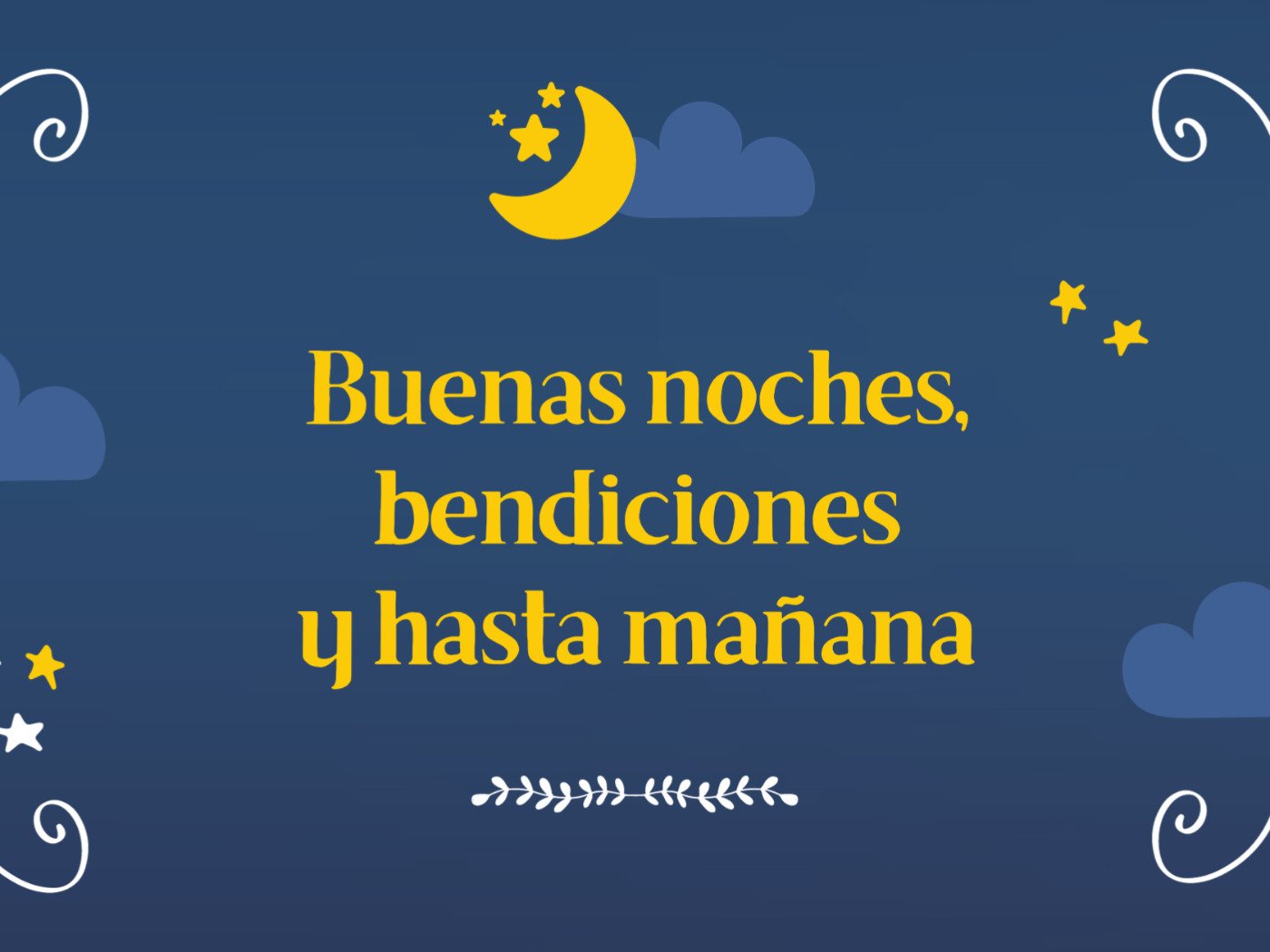
Sleep is a weird thing. Honestly, we spend a third of our lives unconscious, and yet we treat the transition into that state with such casual routine. But for millions of people in Spanish-speaking cultures, that transition isn't complete without a specific ritual. You've heard it a thousand times. Bendiciones hasta mañana buenas noches. It’s a mouthful, right? It’s not just "goodnight." It’s a layered, protective, and deeply emotional sequence of words that anchors a person before they drift off into the dark.
Most people think these phrases are just placeholders. Like saying "have a nice day" to a cashier you’ll never see again. They’re wrong.
In many households, especially across Latin America and the Hispanic diaspora in the US, these words are a psychological safety net. It’s about connection. When you tell someone "bendiciones hasta mañana buenas noches," you are essentially saying, "I recognize your existence, I wish for your safety while you are vulnerable in sleep, and I fully expect to see you when the sun comes up."
It’s heavy stuff if you actually think about it.
The cultural weight of bendiciones hasta mañana buenas noches
Why do we say it exactly like that?
Language evolves based on what a culture values most. In Hispanic culture, family and faith—whether strictly religious or just spiritual—are the bedrock. The word bendiciones (blessings) acts as a verbal shield. It’s not just a religious "God bless you." It’s an invocation of good energy.
I’ve talked to sociologists who study linguistic rituals, and they often point out that "buenas noches" on its own feels a bit cold in a family setting. It’s formal. Adding "hasta mañana" (until tomorrow) provides the promise of continuity. It’s the "see you later" that wards off the subconscious fear of the unknown. When you combine them into the full bendiciones hasta mañana buenas noches, you’ve covered all your bases. You’ve blessed them, you’ve promised a reunion, and you’ve acknowledged the night.
It’s efficient. It’s also incredibly comforting.
Think about the psychology of a child. Nighttime is scary. Monsters under the bed, the dark, being alone in a room. When a parent says these words, they are creating a closed loop of security. Research from the Sleep Foundation suggests that pre-sleep rituals—even verbal ones—can significantly lower cortisol levels. If your brain knows the "exit ritual" has been performed, it relaxes.
Does it actually help you sleep better?
Short answer: yeah, probably.
Long answer: it’s about the parasympathetic nervous system. If you go to bed stressed or feeling disconnected, your brain stays in a state of hyper-vigilance. You know that feeling. You’re lying there, staring at the ceiling, thinking about that email you didn't send. But if you have a shared ritual of wishing blessings, it signals to the brain that the social environment is safe.
Social safety is a huge predictor of sleep quality.
Dr. Wendy Troxel, a senior behavioral scientist at the RAND Corporation, has written extensively about how our relationships affect our sleep. While her work often focuses on couples, the principle applies to the whole house. Verbalizing peace and blessings creates a "shared sleep space" that feels protected.
Digital blessings and the WhatsApp phenomenon
If you have a Tía or a grandmother on WhatsApp, you know exactly what I’m talking about. Your phone probably vibrates at 9:00 PM every single night.
It’s an image.
Usually, it’s a picture of a sparkling rose, or a sleeping kitten, or maybe a very serene-looking Jesus, with the text bendiciones hasta mañana buenas noches glowing in a neon font. Sometimes there are glitter GIFs involved. It’s easy to joke about it. It’s easy to call it "boomer energy."
But look closer.
This is the digital evolution of a centuries-old oral tradition. In a world where families are often separated by borders—especially in the context of migration—these messages are a bridge. My friend Elena, who moved from Mexico City to Chicago, gets these messages from her mother every night. She told me once that if her mom forgets to send the "bendiciones" text, she actually feels a physical pang of anxiety.
It’s a tether.
In 2026, we’re more digitally connected than ever, but we’re also lonelier. These repetitive, almost "spammy" nightly blessings are a way of saying "I’m still here, and you’re still mine." It’s a digital hug.
Breaking down the phrase: A linguistic breakdown
Let’s get nerdy for a second.
- Bendiciones: Plural. Not just one blessing, but many. It’s an abundance mindset.
- Hasta mañana: This is the most important part for many. It sets a goal. We are going to make it through the night.
- Buenas noches: The standard, polite acknowledgment of the time of day.
When you put them together, you get a rhythmic, almost melodic cadence. Try saying it out loud. It has a flow. It’s a "tricolon" in rhetorical terms—a series of three parallel words or phrases. Humans love things that come in threes. It feels complete.
Misconceptions about the ritual
A lot of people think you have to be deeply religious to use this phrase. Not really. While the roots are definitely Catholic, the modern usage has become more of a cultural idiom.
I’ve seen secular families use it. I’ve seen teenagers say it to their friends—maybe a bit more ironically, but the sentiment remains. It’s become a "vibe" more than a prayer.
Another misconception is that it’s only for old people. While it’s true that the older generation is more "prolific" with the blessings, there is a massive resurgence among Gen Z and Millennials who are looking for ways to reconnect with their heritage. They might not be going to Mass, but they are definitely sending the "bendiciones" text.
It’s a form of "reclaiming" identity.
Practical ways to use this (even if you aren't Spanish)
You don't have to be a native speaker to understand the value of a high-quality "goodnight." We all need a better way to end the day than just scrolling TikTok until our eyes bleed and we pass out from exhaustion.
Honestly, our current "sleep hygiene" is a disaster.
We stare at blue light. We read depressing news. Then we wonder why we have vivid nightmares about the economy. Incorporating a verbal ritual—whether it’s bendiciones hasta mañana buenas noches or some other meaningful phrase—can act as a hard stop for the day's stress.
- Say it to yourself. If you live alone, internalize the sentiment. Give yourself permission to be "done" for the day.
- Text your people. Not just a "gn," but something with some weight to it.
- Be consistent. The power of a ritual is in the repetition.
Why the "Hasta Mañana" part matters for mental health
There’s a concept in psychology called "prospective memory." It’s our ability to remember to do things in the future. By saying "until tomorrow," you are subtly priming your brain for a future state. You are planning to exist tomorrow.
For people struggling with depression or high anxiety, nighttime is the hardest. The world gets quiet. The thoughts get loud. Having a standard phrase that promises a tomorrow can be a small, but significant, anchor. It’s a micro-affirmation.
The darker side of the "Goodnight"
Is there a downside? Maybe. Sometimes these phrases can become so rote that we stop meaning them. We say them like "bless you" after a sneeze. When that happens, the emotional weight evaporates.
If you find yourself just mucking through the words, stop. Take a breath. Look the person in the eye—or actually think about the person you’re texting.
The intentionality is where the magic is.
I remember reading a study about "phatic communication"—which is basically language that doesn't convey information but performs a social function (like "How are you?"). The study suggested that while the words themselves might be "empty" of new info, they are "full" of social bonding. Bendiciones hasta mañana buenas noches is the ultimate phatic expression. It tells the other person they are safe in your world.
Making the ritual stick
If you want to start using this or a similar ritual to improve your nightly routine, don't overthink it. It's not a performance.
- Start with your immediate circle. Your partner, your kids, or even your dog. Yes, dogs count.
- Acknowledge the transition. Use the phrase as the signal to put the phone away.
- Vary the delivery. Sometimes it’s a whisper, sometimes it’s a text, sometimes it’s a long-distance call.
The goal isn't to be perfect; it's to be present. The night is long, and the world is loud. Taking three seconds to say bendiciones hasta mañana buenas noches isn't just about being polite. It's about building a fortress of words around the people you care about before the lights go out.
Go ahead. Send the text. Say the words. Your nervous system—and your grandmother—will thank you.
Your Nightly Action Plan
To turn this cultural habit into a personal wellness tool, follow these specific steps:
- Set a "Digital Sundown": 20 minutes before you want to sleep, send your last "blessings" or goodnight messages. This prevents the "just one more scroll" trap.
- Use the Full Phrase: Instead of shortening it to "gn" or "buenas," use the full bendiciones hasta mañana buenas noches. The extra time it takes to type or say it helps shift your brain into a slower gear.
- Reflect on the "Hasta Mañana": As you say it, briefly identify one thing you are looking forward to the next day. This attaches a positive "future-hook" to your sleep cycle.
- Forgive the Silence: If you don't get a "bendicion" back, don't sweat it. The benefit comes just as much from the act of giving the blessing as it does from receiving it.