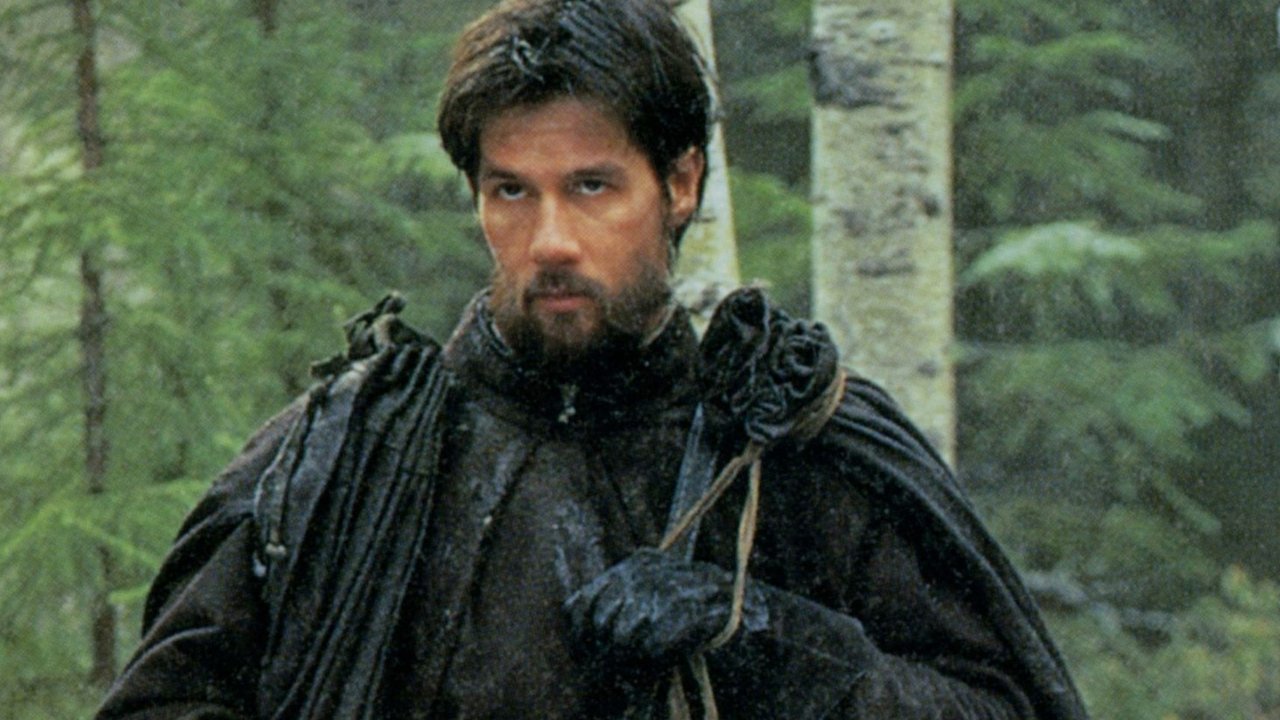
History isn't usually pretty. Most Hollywood epics about the "New World" tend to lean into the sweeping vistas and the noble-savage tropes, or they go the other way into pure exploitation. But then there’s Black Robe the movie. Released in 1991 and directed by Bruce Beresford, it doesn't care about your comfort. It’s a cold, jagged piece of cinema that feels more like a documentary captured by a time traveler than a big-budget production. Honestly, if you’ve only ever seen Dances with Wolves, this film is going to feel like a bucket of ice water to the face.
It’s the 1630s. We follow Father Laforgue, a young Jesuit priest—the titular "Black Robe"—who is traveling through the unforgiving wilderness of New France (modern-day Quebec) to reach a remote mission. He’s accompanied by a group of Algonquin guides and a young Frenchman named Daniel. This isn't a story of easy triumphs. It’s about the total, agonizing collision of two worldviews that simply cannot coexist.
The Brutal Realism of Black Robe the Movie
Why does this film still get talked about in film schools and history departments? Because it refuses to take the easy way out. Based on the novel by Brian Moore, who also wrote the screenplay, the story draws heavily from the Jesuit Relations. These were the actual chronicles written by priests in the 17th century. Because the source material is so grounded, the film avoids the "magical" quality often attributed to Indigenous cultures in film.
The Algonquin, the Huron, and the Iroquois are portrayed as complex people with their own biases, their own humor, and their own deep-seated skepticism of the "Black Robe." They think Laforgue is a fool. They think his "water sorcery" (baptism) is weird and potentially dangerous. They aren't sidekicks; they are the masters of a landscape that is actively trying to kill the European intruders.
Beresford, who also directed Driving Miss Daisy, shifted gears completely here. He traded Southern charm for the gray, oppressive light of a Canadian winter. There is no warmth in this movie. You can almost feel the frostbite. The cinematography by Peter James focuses on the sheer scale of the forest and the river, making the humans look like tiny, insignificant specks. It’s a visual reminder that Nature doesn't care about your religion or your colonial ambitions.
A Conflict of Souls
At its heart, Black Robe the movie is about a spiritual stalemate. Laforgue, played with a sort of frantic, repressed intensity by Lothaire Bluteau, truly believes he is saving souls. He thinks he’s bringing light to a dark place. But the Algonquin leader, Chomina (played brilliantly by August Schellenberg), sees a man who is obsessed with a "Death Home" (Heaven) and who can't even paddle a canoe.
One of the most striking things about the film is how it handles language and philosophy. The dialogue doesn't sound like a modern screenwriter trying to be "deep." It’s blunt. The Algonquin characters mock Laforgue’s vow of celibacy. They find it hilarious and unnatural. There’s a scene where they discuss the concept of the soul, and it becomes clear that their understanding of the world is just as sophisticated as the Jesuit's—it’s just built on a completely different foundation.
This leads to a pervasive sense of dread. You know, deep down, that this isn't going to end with everyone shaking hands. The film explores the "Iroquois wars" with a level of violence that is genuinely shocking even by today's standards. It isn't stylized "action" violence. It’s messy, terrifying, and intimate.
Accuracy and the "Jesuit Relations"
The movie sticks remarkably close to the historical record, specifically the accounts of Father Jean de Brébeuf and his peers. The Jesuits were genuinely some of the most educated men in Europe, and they were sent into the wilderness with almost no survival skills, fueled purely by faith.
- The costumes weren't cleaned up for the camera.
- The dwellings—longhouses and birchbark tipis—were reconstructed using period-accurate methods.
- The use of Indigenous languages (Cree, Mohawk, and Algonquin) was a massive deal in 1991.
Most people don't realize that Black Robe the movie was one of the first major productions to prioritize linguistic authenticity over ease of viewing for English audiences. It forces you to live in the subtitles, which further alienates you from Laforgue's perspective. You feel as lost as he does.
The Controversy of Perspective
Is the film perfect? It depends on who you ask. Some historians and Indigenous scholars have pointed out that while it avoids the "Noble Savage" trope, it leans heavily into the "Savage" part during the Iroquois sequences. The Iroquois are depicted as almost demonically cruel. While the historical period was undeniably violent and the Iroquois were indeed expansionist and formidable, the film’s portrayal has been criticized for being one-sided—essentially seeing the Iroquois through the terrified eyes of the Jesuits.
However, others argue that this is the point. The movie is a study of fear. It's about what happens when you're a stranger in a land where you don't understand the rules. The violence isn't there for excitement; it's there to show the stakes of the cultural divide.
Why You Should Watch It in 2026
We live in an era of "elevated" historical drama, but Black Robe the movie still feels more modern than most things coming out today. It doesn't lecture the audience. It doesn't tell you how to feel about Laforgue. Is he a hero? A martyr? A delusional colonizer? The movie lets you decide.
The ending is one of the most haunting in cinema history. No spoilers, but it’s not a victory. It’s a quiet, devastating realization of what "conversion" actually looks like. It’s about the death of a culture and the hollow triumph of a faith that can't provide the answers these people actually need to survive a plague.
Honestly, the sheer craft on display is worth the price of admission. The way the sound design uses the wind and the cracking of ice creates an atmosphere of constant tension. It's a "slow burn" in the truest sense of the word.
Actionable Insights for Cinephiles and History Buffs
If you’re planning to dive into this film, or if you’ve seen it and want to go deeper, here’s how to actually process the experience:
- Read the Source Material: Pick up Brian Moore’s novel. It’s short, punchy, and provides even more internal monologue for Laforgue, which helps explain his bizarre, self-flagellating behavior.
- Compare with 'Silence': If you liked Martin Scorsese’s Silence (2016), you must see Black Robe. They are spiritual siblings. Both deal with Jesuit missions (one in Japan, one in Canada) and the "mudswamp" of a culture that refuses to accept foreign dogma.
- Look into the 'Jesuit Relations': You can find these online. They are the actual primary sources. Reading them makes you realize that some of the "crazier" parts of the movie—like the priest’s obsession with baptizing dying children—were 100% real.
- Check the Cast: Notice a young Sandrine Holt and the legendary August Schellenberg. Schellenberg’s performance is the anchor of the movie; without his dignity and world-weariness, the film would fall apart.
- Watch the Landscapes: The film was shot on location in Quebec, specifically around the Saguenay River. If you’ve ever been to that part of the world, you’ll recognize the rugged, Precambrian Shield beauty that the film captures so well.
There’s a reason this film won the Genie Award (the Canadian Oscars) for Best Picture. It’s an uncompromising look at the "encounter" between Europe and the Americas. It doesn't offer easy answers or feel-good moments. It just offers the cold, hard truth of a winter that never seems to end.
If you want to understand the roots of North American history, you have to look at the moments where things went wrong. Black Robe the movie is the best record we have of those moments. It shows that the "New World" wasn't new at all—it was an ancient, complex world that was about to be changed forever by a man in a black robe who didn't even know how to start a fire.
To get the most out of your viewing, try to find the remastered Blu-ray or a high-definition stream. The dark, moody colors of the forest tend to get "crushed" on low-quality versions, and you lose the incredible detail of the costuming and the environment. Set aside a night where you can actually pay attention; this isn't a "background" movie. It demands your full, undivided, and perhaps slightly shivering, attention.