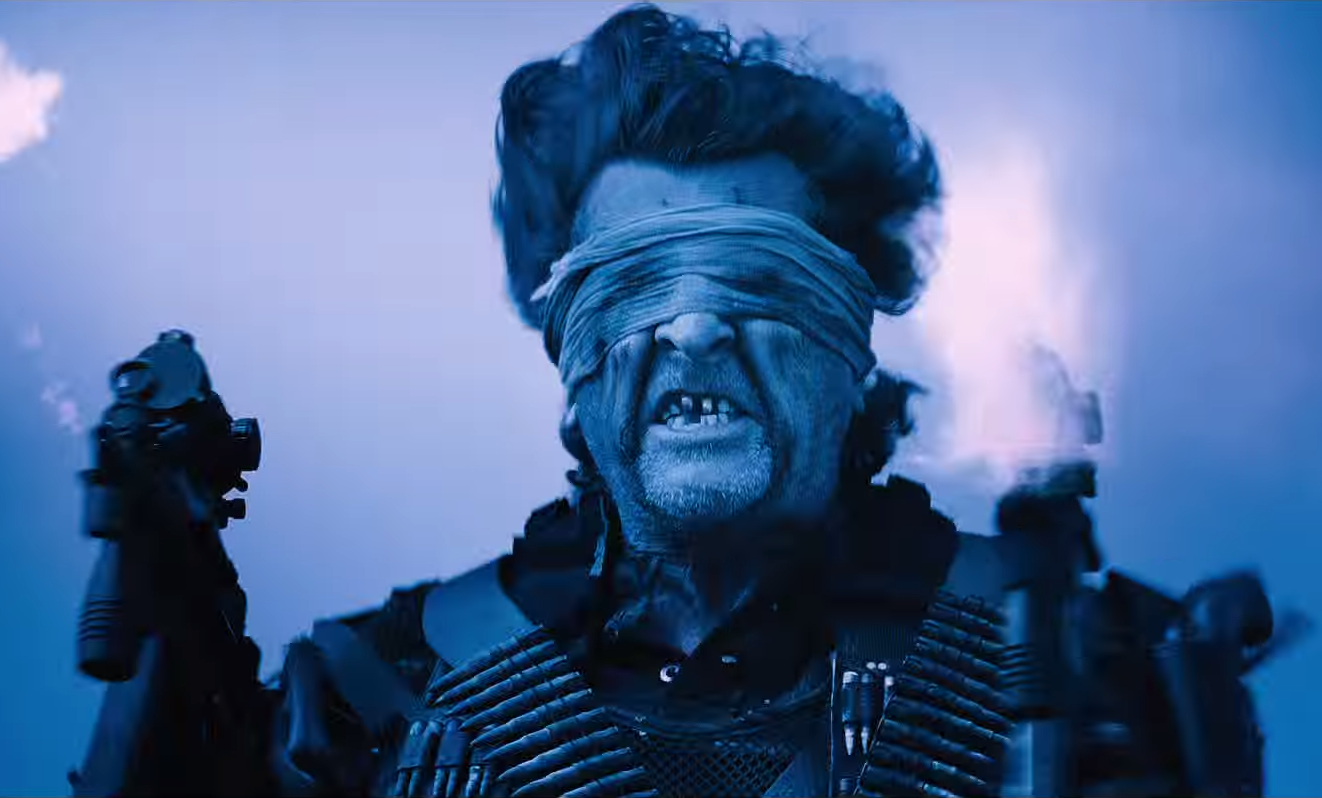
He’s blind. He’s bleeding. He’s screaming about justice while firing two submachine guns into the dark. If you’ve seen Mad Max: Fury Road, you know exactly who I’m talking about. The Bullet Farmer isn't just some side villain with a cool name. He’s a nightmare. Honestly, while Immortan Joe gets all the attention for his plastic chest plate and breathing mask, Major Kalashnikov—the man we know as the Bullet Farmer—represents the raw, industrial insanity of the Wasteland in a way no other character does.
George Miller didn't just throw a guy with a funny hat into the desert. He built a world where everything is a resource, and the Bullet Farmer is the guy who holds the keys to the armory.
Who is the Bullet Farmer?
The backstory is actually pretty grounded, at least for a movie about a guy who turns his head into a literal chandelier of ammunition. Before the world fell apart, he was Major Kalashnikov. He was a soldier. A man of logistics and firepower. When the collapse happened, he didn’t just survive; he seized the lead mines.
The Bullet Farm isn't just a name. It’s a functional industrial site. It’s an old open-pit mine where they manufacture gunpowder and cast slugs. This gives him immense leverage over Immortan Joe and the People Eater. Think about it. Joe has the water. The People Eater has the gas. But Kalashnikov? He has the "seeds." Without him, the War Boys are just guys with sticks.
He’s the third pillar of the triumvirate that rules the Wasteland. But unlike the People Eater, who seems mostly concerned with his ledgers and his swollen feet, the Bullet Farmer loves the work. He’s a zealot. When Furiosa flees with the Five Wives, he doesn't just send a few scouts. He brings the heat. Literally.
The Design of Absolute Madness
Look at his outfit. It’s absurd. It’s also genius character design. Actor Richard Carter (who sadly passed away in 2019) brought a frantic, jagged energy to the role that felt dangerous. He wears a headpiece made of bullets. He has bandoliers draped over every inch of his body. He even has silver "chrome" teeth, just like the War Boys he leads.
But it’s the vehicle that really steals the show. The Peacemaker.
It’s a 1970s Chrysler Valiant Charger body welded onto a Ripsaw tracked chassis. It’s fast. It’s heavy. It’s also the only thing that could actually chase the War Rig through the "Night Bog." While Joe’s big monster trucks are sinking into the mud, the Bullet Farmer is just gliding over it on tracks, screaming about "singing" to the heavens.
There is a specific moment in the film that defines him. After being blinded by a stray shot from Max, he doesn't retreat. He doesn't call for a medic. He wraps his head in bloody bandages, holds two weapons out like scales of justice, and starts spraying lead into the void. He calls himself the "Judge, Jury, and Executioner." It’s a terrifying look at what happens when military discipline meets religious fanatacism.
The Logistics of the Bullet Farm
How does a "Bullet Farmer" actually work? In the Mad Max lore—specifically the comics and the 2015 video game—we get a clearer picture of his operation. It’s a hellscape.
- The mines are staffed by "slavelings" who spend their lives breathing in lead dust and sulfur.
- They don't just make bullets; they reload old casings.
- The trade economy is brutal: 1 liter of "Guzzoline" for a handful of rounds.
You can see why Joe keeps him close. In the Wasteland, a gun without a bullet is just a heavy club. By controlling the means of production, the Bullet Farmer ensures he’s indispensable. He isn't just a general; he’s the CEO of the only manufacturing plant left on the planet.
Why the "Night Bog" Sequence Changes Everything
For a lot of fans, the sequence where the Bullet Farmer hunts the protagonists in the swamp is the peak of the movie's tension. The color grading shifts to that deep, haunting blue. Everything feels slow. Except for him.
He’s the only one who can move.
When Max heads off into the fog to "deal" with him, we don't see the fight. We only hear it. We see distant flashes of orange light. We hear the roar of the Peacemaker’s engine. Then, Max returns covered in blood—not his own—carrying a sack of guns and ammo. It’s one of the few times we see the legendary Max Rockatansky look genuinely rattled.
The Bullet Farmer was a man who had nothing left to lose. He had lost his sight, his soldiers, and his dignity. All he had left was his "children" (the bullets). That kind of enemy is the hardest to kill.
The Symbolism Most People Miss
The Bullet Farmer is a critique of the military-industrial complex taken to its most literal, grotesque extreme. He represents the "War" part of the "War, Famine, and Pestilence" trio. While Immortan Joe represents the hoarding of natural resources (water) and the People Eater represents the greed of commerce (fuel), Kalashnikov is pure, unadulterated violence.
He calls his bullets "seeds." He thinks he’s planting a future.
"I am the scales of justice! Conduct of the choir!"
He actually believes he’s doing something holy. That’s what makes the villains in Fury Road so much more effective than your standard movie bad guys. They aren't just "evil." They have a philosophy. They have a culture. It’s a disgusting, warped culture, sure, but it’s consistent.
The Legacy of Richard Carter
We have to talk about Richard Carter’s performance. He wasn't a huge name globally, but in Australia, he was a legend. He brought a theatricality to the Bullet Farmer that could have easily been "too much," but in the context of Miller’s world, it fit perfectly. He snarled. He spat. He seemed like he was vibrating with high-octane adrenaline the entire time he was on screen.
When you watch the behind-the-scenes footage, you see how much work went into that Peacemaker vehicle. It wasn't CGI. They actually built that tracked monster and sent it flying through the dirt. Carter had to sit in that thing while it bucked and roared. That physical reality translates to the screen. You can see the grime under his fingernails.
Practical Insights for Mad Max Fans
If you're looking to dive deeper into the lore of the Bullet Farmer or the world of Fury Road, there are a few specific places to look that aren't just the movie.
First, track down the Vertigo comic book series. There is an entire issue dedicated to the origins of the three leaders. It explains how Kalashnikov was a Colonel in the Australian Army and how he helped Joe Moore (Immortan Joe) take the Citadel in the first place. It makes their bond make a lot more sense. They weren't just allies; they were brothers-in-arms.
Second, if you play the 2015 Mad Max game, you can actually visit the Bullet Farm. It’s a massive, vertical industrial nightmare built into a canyon. Seeing the scale of the operation helps you understand why the character is so arrogant. He doesn't just have a gun; he has a mountain that spits fire.
Finally, pay attention to the sound design next time you watch his scenes. The sound of the Peacemaker is different from every other car. It has a rhythmic, metallic clacking because of the tracks. It sounds like a machine gun. It’s intentional.
The Bullet Farmer died in the mud, blinded and screaming, but he remains one of the most vivid examples of how George Miller uses costume, vehicle, and dialogue to tell a story without needing a single "as you know" exposition dump. He’s a terrifying reminder that even at the end of the world, there will always be someone ready to sell you a bullet for the price of your soul.
To truly understand the impact of this character, re-watch the Peacemaker's introduction during the "Caddy" chase. Notice how he treats his ammunition—almost like jewelry or religious relics. This isn't just gear; it's his entire identity. If you want to explore more about the mechanical builds of the film, look into the work of Peter Pound, the principal concept artist who spent years dreaming up these rolling nightmares before a single frame was shot.
Next Steps for Enthusiasts:
- Source the Comics: Look for Mad Max: Fury Road - Furiosa #1 and the Immortan Joe & The People Eater one-shots for the full backstory on the fall of the Major.
- Analyze the Peacemaker: Research the "Ripsaw EV2" chassis to see how the real-world vehicle was adapted for the film.
- Compare the Villains: Re-watch the "Night Bog" sequence and contrast the Bullet Farmer’s frantic energy with the People Eater’s calculated cowardice to see how Miller balances his antagonist trio.