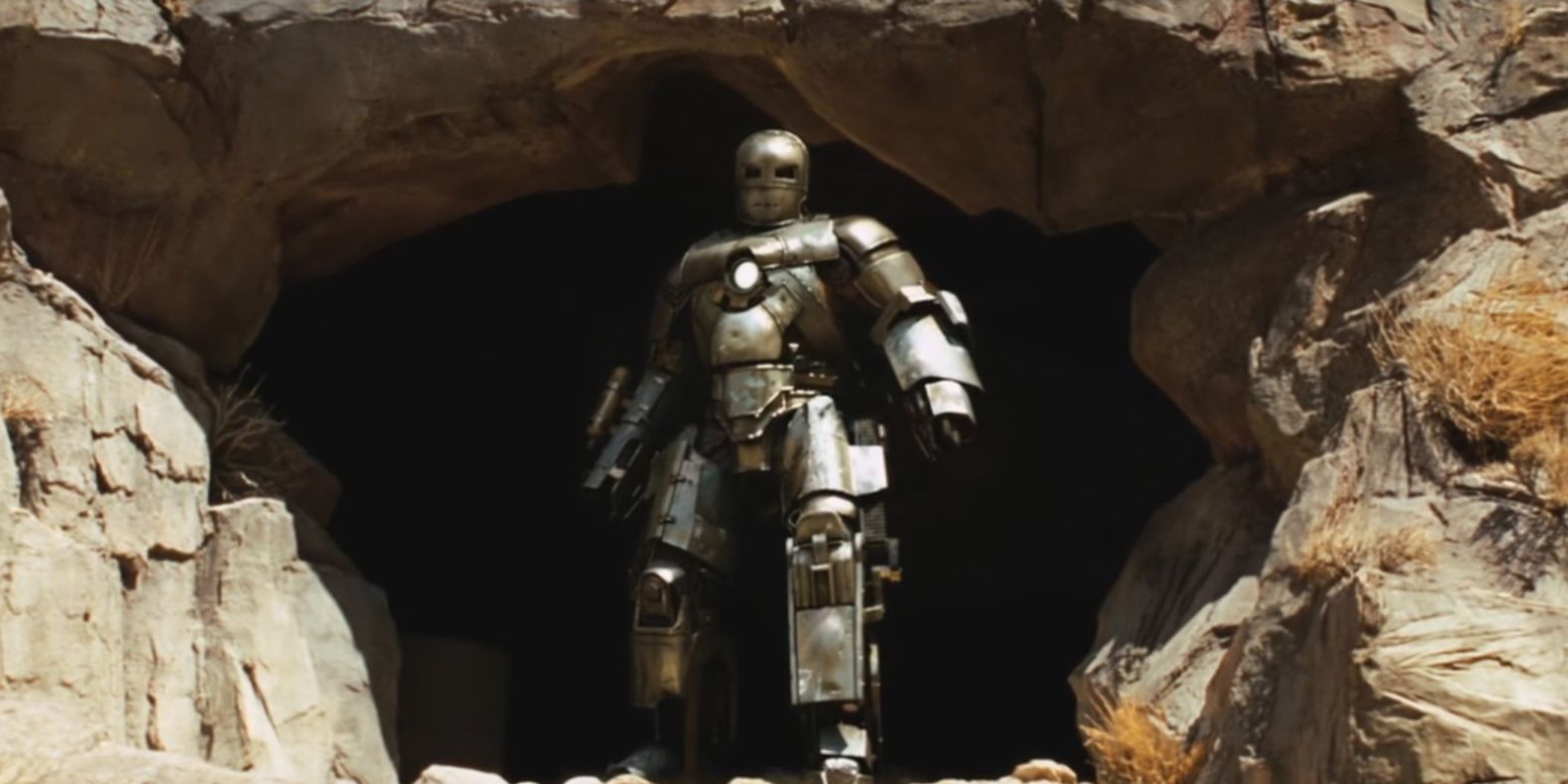
Tony Stark didn't build this in a lab. He didn't have a team of MIT-trained engineers or a billion-dollar automated assembly line. Honestly, the Iron Man armor Mark 1 shouldn't have worked at all. It was a literal "hail Mary" play made of scrap metal, salvaged missile parts, and desperation. If you look closely at the design, it’s ugly. It’s clunky. It looks like a walking wood stove. But that’s exactly why fans still obsess over it nearly two decades after it first appeared on the big screen in 2008.
The suit represents the moment the MCU actually became interesting. Before the sleek nanotech and the space-faring suits, there was just a guy in a cave trying not to die.
The Anatomy of a Junk Heap
Let’s talk about what the Iron Man armor Mark 1 actually is. It isn't made of high-grade titanium-gold alloy. Stark and Ho Yinsen cobbled it together using parts from Stark Industries Jericho missiles—specifically the metal casing and the internal electronics. You’ve got a manual crank on the back just to get the thing started. Imagine that. You’re in a life-or-death situation and you need someone to wind you up like a toy.
The propulsion was basically crude solid-fuel rocket boosters. It wasn't "flight" so much as "controlled falling." It had one job: get Tony out of the camp. The weaponry was equally basic but terrifying. He had two flamethrowers—one on each arm—and a single-fire missile launcher. It was built for intimidation and raw power, not finesse.
What People Get Wrong About the Iron Man Armor Mark 1
A lot of people think the suit was bulletproof. It wasn’t. Not really. While the thick iron plating could stop low-caliber rounds from the Ten Rings’ stolen weaponry, the joints were exposed. It had massive gaps. If a stray bullet had hit the internal wiring or the crude leather straps holding the plates together, Tony would have been a sitting duck.
Another misconception is the power source. The original Arc Reactor—the one Yinsen helped Tony build—wasn't just for the suit. It was a pacemaker. Its primary function was to keep the shrapnel from entering Tony’s heart. Powering the suit was a secondary, almost suicidal, drain on that energy. The UI was nonexistent too. No J.A.R.V.I.S. No heads-up display. Just a small slit in the helmet that gave Tony about 10 degrees of peripheral vision. He was basically blind in that thing.
The Design Philosophy of Necessity
Phil Saunders and Adi Granov, the conceptual artists who worked on the first Iron Man film, didn't want a superhero suit. They wanted a tank you could wear. If you look at the design sketches, they emphasized the weight. In the movie, you can hear every hiss of the hydraulics and the heavy thud of the boots. It feels real. It feels like it weighs 1,500 pounds because, in the fiction of the world, it probably did.
The suit was a reflection of Tony’s transition. He went from a man who sold "freedom" through destruction to a man who had to build his own freedom out of the very weapons he created. It’s poetic, sure, but it’s also just good engineering. He used what was available.
- He used leather from work aprons for the internal harness.
- He scavenged copper wire for the motor coils.
- He used a man-portable welding kit to fuse the chest plate.
Why It Still Holds Up Against Nanotech
Later suits like the Mark 85 are basically magic. They appear out of nowhere. They can form shields and blades. They're cool, but they lack the "crunch." The Iron Man armor Mark 1 had stakes. When Tony is walking through that cave, you feel the heat of the flamethrowers. You feel the panic when the suit starts to lose power.
There’s a specific grit to the Mark 1 that the later MCU movies moved away from. In Iron Man 3, we see the "bones" of the suit technology again with the Mark 42, but even that felt sophisticated. The Mark 1 is the only suit that feels like it could actually exist in a garage today—if you were a genius with a death wish.
The Legacy in the MCU
Marvel knows how much people love this hunk of junk. That's why they brought it back in Spider-Man: Far From Home as an illusion, and why the "clinking" sound of Tony hammering the metal plays at the very end of Avengers: Endgame. It’s the heartbeat of the franchise. It’s a reminder that Stark’s true superpower wasn't the suit, but the mind that could build it under pressure.
Interestingly, the suit didn't just disappear after it crashed in the desert. The Ten Rings gathered the pieces. Obadiah Stane then used those pieces to create the Iron Monger. That’s a crucial detail. The Iron Monger isn't an evolution of the Mark 3; it's a bloated, weaponized version of the Mark 1. It’s the "dark mirror" version of Tony’s first invention.
How to Appreciate the Mark 1 Today
If you’re a collector or a fan, looking at the Mark 1 requires a different lens. You shouldn't look for perfection. You should look for the weld marks. Look for the mismatched bolts. If you’re ever at a convention or seeing a prop replica, check the back—that’s where the "unfinished" nature of the suit really shows. It was never meant to be a finished product. It was a prototype for survival.
Actionable Insights for Fans and Creators:
- Analyze the "Constraint" Principle: If you're a writer or designer, look at how the Mark 1 uses limitations to create character. Tony didn't have everything, so he had to be creative. Constraints often lead to better design than unlimited resources.
- Rewatch with Audio Focus: Go back and watch the cave escape from the 2008 film. Turn up the volume. Pay attention to the mechanical whirring versus the digital sounds of later movies. It’s a masterclass in sound design.
- Study the Proportions: Notice how the Mark 1 changes Tony's silhouette. It makes him hulking and asymmetrical. Use this as a reference for "low-tech" sci-fi aesthetics—it's the gold standard for a reason.
- Check the Easter Eggs: Look for the Mark 1 in the background of the Hall of Armor in later films. Tony kept it. Not because it was useful, but because it was his most important lesson: don't waste your life.
The Iron Man armor Mark 1 isn't just a costume. It’s a narrative device that grounded a flying superhero in a world of grease, fire, and cold hard iron. It’s the reason we cared about Tony Stark in the first place. He wasn't born a hero; he hammered himself into one.